Back

Cis vs Trans quiz

Control buttons has been changed to "navigation" mode.
1/9
  • What are cis-trans isomers?

    Cis-trans isomers are stereoisomers where groups are arranged on either the same side (cis) or opposite sides (trans) of a double bond or ring.
  • What is a defining characteristic of trans fats?

    Trans fats contain trans double bonds, where the hydrogen atoms are on opposite sides of the double bond, affecting their physical properties.
  • What is true about trans fats in terms of their chemical structure and health impact?

    Trans fats are unsaturated fats with trans double bonds, which can impact health differently than cis fats.
  • What health effects are associated with trans fats due to their chemical structure?

    Trans fats have trans double bonds, which can lead to different health effects compared to cis fats.
  • What property of double bonds accounts for the two different types of unsaturated fat?

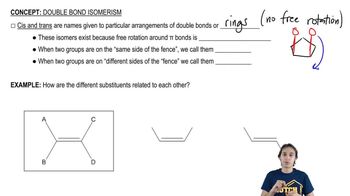
    The lack of free rotation around double bonds leads to cis and trans configurations, resulting in different types of unsaturated fats.
  • What is the 'fence' analogy used for in cis-trans isomerism?

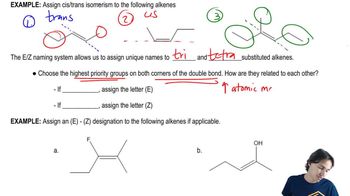
    The 'fence' analogy helps determine cis (same side) and trans (opposite sides) configurations by drawing a line through the double bond.
  • Why can't cis-trans naming be used for multi-substituted alkenes?

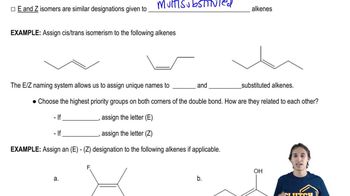
    Cis-trans naming is insufficient for multi-substituted alkenes, requiring the E/Z system to describe complex configurations.
  • How does the E/Z naming system assign priority to substituents?

    The E/Z system assigns priority based on atomic mass to the substituents on each end of the double bond.
  • What does 'E' denote in the E/Z naming system?

    'E' denotes a trans-like arrangement where high-priority groups are on opposite sides of the double bond.