How can you determine if substituents on a double bond or ring are cis to each other?
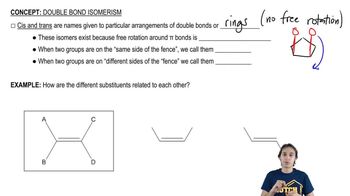
Substituents are cis to each other if they are on the same side of the double bond or ring, as determined by drawing a line (the 'fence') through the double bond or ring and comparing the positions of the groups.
Which types of compounds can exist as cis-trans isomers?
Compounds with double bonds or rings that have two different substituents on each carbon of the double bond or at different positions on the ring can exist as cis-trans isomers, provided there is no free rotation.
How do you identify the structure of trans-3-hexene?
Trans-3-hexene is an alkene with a double bond between the third and fourth carbons of hexene, where the substituents on each carbon of the double bond are on opposite sides.
How can you determine if a pair of compounds are cis-trans isomers?
A pair of compounds are cis-trans isomers if they have the same connectivity but differ in the arrangement of substituents around a double bond or ring, with one having substituents on the same side (cis) and the other on opposite sides (trans).
How do you identify the relationship of substituents as cis or trans on a chair structure of cyclohexane?
On a chair structure of cyclohexane, substituents are cis if they are both on the same side (both axial or both equatorial and both up or both down), and trans if they are on opposite sides (one up and one down, or one axial and one equatorial).
Which molecules can have cis-trans isomers?
Molecules with double bonds or rings that have two different substituents on each carbon of the double bond or at different positions on the ring can have cis-trans isomers.
Which hydrocarbon has all of its atoms in the same plane?
Ethylene (ethene), which has a double bond between two carbon atoms, has all its atoms in the same plane due to the planar nature of the sp2 hybridized carbons.
How many pairs of electrons are shared between two adjacent carbon atoms in a saturated hydrocarbon?
In a saturated hydrocarbon (alkane), two adjacent carbon atoms share one pair of electrons, forming a single covalent bond.
When two carbon atoms form a double bond and each is bound to two hydrogen atoms, what is true about the molecule's geometry?
The molecule is planar around the double bond, and the lack of free rotation allows for the possibility of cis-trans isomerism.
What structural feature is required to accommodate a trans C=C double bond?
A trans C=C double bond requires two different substituents on each carbon of the double bond, with the substituents on opposite sides of the double bond.
How are cis-trans isomers best described in organic chemistry?
Cis-trans isomers (geometric isomers) are molecules with the same connectivity but different spatial arrangements of substituents around a double bond or ring due to restricted rotation.
Which molecules can have both cis and trans configurations?
Molecules with double bonds or rings that have two different substituents on each carbon of the double bond or at different positions on the ring can have both cis and trans configurations.
What are cis-trans isomers (geometric isomers)?
Cis-trans isomers are molecules with the same connectivity but different arrangements of substituents around a double bond or ring, resulting from restricted rotation.
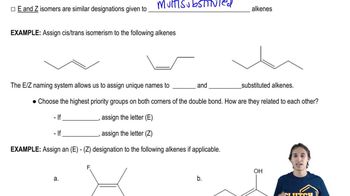
How do you determine if an alkene is E, Z, or neither?
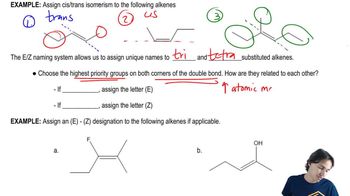
Assign priorities to the substituents on each carbon of the double bond based on atomic mass; if the highest priority groups are on the same side, it is Z (cis-like); if on opposite sides, it is E (trans-like); if there are not enough substituents, it is neither.
How do you draw line structures for the cis and trans configurations of CH3CH2CH=CHCH3?
For cis-2-pentene, draw the ethyl and methyl groups on the same side of the double bond; for trans-2-pentene, draw them on opposite sides.
How do you identify atoms that are trans to a bromo substituent in a substituted cyclohexane?
Atoms that are trans to a bromo substituent in cyclohexane are those located on the opposite side of the ring (one up, one down) relative to the bromo group.
What is the configuration of cis-1-isopropyl-2-methylcyclohexane?
In cis-1-isopropyl-2-methylcyclohexane, the isopropyl and methyl groups are on the same side of the cyclohexane ring (both up or both down).
How do you identify the configurations around the double bonds in a compound?
For each double bond, determine the arrangement of substituents; if two different groups are on the same side, it is cis; if on opposite sides, it is trans; for more than two substituents, use the E/Z system based on priority.
How do you identify the relationship of substituents as cis or trans on a chair structure?
On a chair structure, substituents are cis if both are on the same side (both up or both down), and trans if they are on opposite sides (one up and one down).
What is the configuration of cis-1-tert-butyl-4-ethylcyclohexane?
In cis-1-tert-butyl-4-ethylcyclohexane, the tert-butyl and ethyl groups are on the same side of the cyclohexane ring (both up or both down).
How do you identify atoms that are trans to a bromine atom in a cyclohexane ring?
Atoms trans to a bromine atom in a cyclohexane ring are those located on the opposite side of the ring (one up, one down) relative to the bromine.