Conformational Isomers quiz #1 Flashcards

Conformational Isomers quiz #1
Control buttons has been changed to "navigation" mode.
1/10
  • What is a conformer of butane, and how can you identify if a given structure is not a conformer?
    A conformer of butane is any arrangement of its atoms resulting from rotation around its single (sigma) bonds, without changing the connectivity of the atoms. If a structure cannot be obtained by rotation around single bonds and involves a change in atom connectivity, it is not a conformer.
  • Which conformer of an acyclic alkane generally has the highest energy, and why?
    The eclipsed conformer of an acyclic alkane generally has the highest energy because the atoms or groups are aligned, leading to increased electron repulsion and torsional strain.
  • What is a true statement about the conformations of acyclic alkanes?
    Acyclic alkanes can exist in multiple conformations due to free rotation around their single (sigma) bonds, and these conformations do not change the connectivity of the atoms.
  • Describe the lowest energy conformation of an acyclic alkane and explain why it is favored.
    The lowest energy conformation of an acyclic alkane is the staggered conformation, where atoms or groups are positioned as far apart as possible, minimizing electron repulsion and torsional strain.
  • How would you rank four conformations of 2-methylbutane from lowest to highest energy based on their relative arrangements?
    Conformations of 2-methylbutane are ranked from lowest to highest energy as follows: staggered conformations (with bulky groups as far apart as possible) have the lowest energy, while eclipsed conformations (with groups aligned) have the highest energy. The more steric hindrance and torsional strain present, the higher the energy.
  • How can you estimate the strain energy of a given conformation of 2,3-dimethylbutane?
    To estimate the strain energy of a conformation of 2,3-dimethylbutane, analyze the degree of torsional strain (from eclipsed interactions) and steric strain (from bulky groups being close together). The more eclipsed and sterically hindered the conformation, the higher the strain energy.
  • Why do single (sigma) bonds in organic molecules allow for multiple conformations?
    Single (sigma) bonds have one region of overlap, making it easy for atoms to rotate without changing the bond's identity. This rotation leads to different conformations without altering atom connectivity.
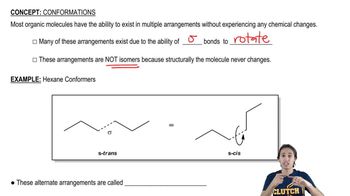
  • How does the ability to rotate around a single bond affect the appearance of a molecule like hexane?
    Rotation around single bonds means hexane can adopt various shapes, not just the typical zig-zag structure. The molecule may appear crumpled or differently arranged due to constant conformational changes.
  • What distinguishes the s-cis and trans conformations in hexane when considering single bond rotation?
    The trans conformation has large groups on opposite sides of the bond, while the s-cis conformation has them on the same side. Single bonds allow hexane to freely switch between these conformations.
  • Why are conformers not considered isomers in organic chemistry?
    Conformers result from rotation around single bonds and do not change the connectivity of atoms. Isomers, in contrast, involve a change in atom connectivity or arrangement.