Back

Conjugate Addition definitions

Control buttons has been changed to "navigation" mode.
1/15
  • Enone

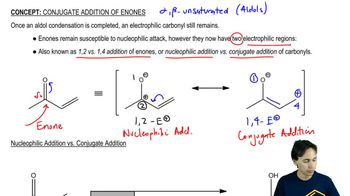
    Alpha, beta-unsaturated carbonyl compound formed from aldol condensation, featuring two electrophilic regions due to resonance.
  • Aldol Reaction

    Process forming beta-hydroxy carbonyls, which upon dehydration yield enones capable of further nucleophilic or conjugate additions.
  • Conjugate Addition

    Nucleophilic attack at the beta carbon (4 position) of an enone, typically leading to loss of the double bond at that site.
  • Nucleophilic Addition

    Attack by a strong nucleophile at the carbonyl carbon (2 position) of an enone, producing a substituted alcohol with a double bond.
  • Resonance Structure

    Alternative electron arrangements in enones that reveal multiple electrophilic sites, influencing reactivity.
  • Grignard Reagent

    Strong organomagnesium nucleophile favoring 1,2-addition to enones, resulting in alcohols with retained double bonds.
  • Organolithium

    Highly reactive organometallic nucleophile that prefers 1,2-addition to enones, similar to Grignard reagents.
  • Gilman Reagent

    Lithium dialkylcuprate, a weaker organometallic nucleophile, favoring conjugate (1,4) addition to enones.
  • Michael Reaction

    Conjugate addition of an enolate to an enone, forming a 1,5-dicarbonyl compound capable of further cyclization.
  • Stork Enamine Synthesis

    Conjugate addition of an enamine to an enone, also yielding a 1,5-dicarbonyl intermediate.
  • Enolate

    Resonance-stabilized anion derived from deprotonation of a carbonyl compound, acting as a nucleophile in Michael reactions.
  • Enamine

    Nitrogen-containing nucleophile with a double bond, used in Stork synthesis for conjugate addition to enones.
  • 1,5-Dicarbonyl

    Product of Michael or Stork reactions, featuring two carbonyl groups separated by three carbons, prone to cyclization.
  • Electrophilic Region

    Site within an enone susceptible to nucleophilic attack, determined by resonance and position relative to the carbonyl.
  • Cyclization

    Transformation where a linear 1,5-dicarbonyl intermediate forms a six-membered ring, often following conjugate addition.