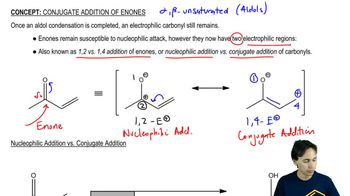
What is conjugate addition in the context of enones?
Conjugate addition is the reaction of a nucleophile with the 4-position (beta carbon) of an enone, also known as 1,4-addition.
What are enones and how are they typically formed?
Enones are alpha, beta-unsaturated carbonyl compounds, usually formed as products of aldol condensation reactions.
What are the two electrophilic positions in an enone and how are they numbered?
The two electrophilic positions are the 2-position (adjacent to the carbonyl, called 1,2) and the 4-position (beta to the carbonyl, called 1,4).
Which nucleophiles typically react at the 1,2-position of an enone?
Strong nucleophiles like Grignard reagents and organolithiums typically react at the 1,2-position.
What is the main product when a Grignard reagent reacts with an enone?
The main product is a substituted alcohol with a double bond remaining in the molecule.
Which nucleophiles commonly undergo conjugate (1,4) addition with enones?
Nucleophiles such as CN-, Gilman reagents (lithium dialkylcuprates), enolates, and enamines commonly undergo conjugate addition.
What is a Gilman reagent and how does it react with enones?
A Gilman reagent is lithium dialkylcuprate (R2CuLi), and it reacts with enones via conjugate (1,4) addition.
What is the Michael reaction?
The Michael reaction is a conjugate addition where an enolate attacks the 4-position of an enone, forming a 1,5-dicarbonyl compound.
What is the Stork enamine synthesis?
The Stork enamine synthesis is a conjugate addition where an enamine acts as the nucleophile, also producing a 1,5-dicarbonyl compound.
Why are 1,5-dicarbonyl compounds significant in organic synthesis?
1,5-dicarbonyls are significant because they can cyclize and self-condensate to form six-membered rings.
What is the difference between nucleophilic addition and conjugate addition in enone chemistry?
Nucleophilic addition (1,2) occurs at the carbonyl carbon, while conjugate addition (1,4) occurs at the beta carbon of the enone.
Why do most nucleophiles prefer conjugate addition over nucleophilic addition with enones?
Most nucleophiles prefer conjugate addition because the 4-position is more reactive for weaker nucleophiles, while only very strong nucleophiles attack the 2-position.
What is the product of a generic nucleophile attacking the 4-position of an enone?
The product is a compound where the nucleophile is added at the 4-position and the double bond is no longer present.
Can enones undergo multiple reactions after their initial formation?
Yes, enones can undergo further reactions such as conjugate addition, leading to a variety of products that can further react or cyclize.
What is a common misconception about the reactivity of enones after aldol condensation?
A common misconception is that enones stop reacting after aldol condensation, but they can actually undergo further reactions like conjugate addition.