Constitutional Isomers quiz #1 Flashcards

Constitutional Isomers quiz #1
Control buttons has been changed to "navigation" mode.
1/24
  • What are constitutional isomers in organic chemistry?
    Constitutional isomers are compounds that have the same molecular formula but different connectivity of atoms, meaning the atoms are bonded in different arrangements.
  • How can you systematically determine if two molecules are constitutional isomers?
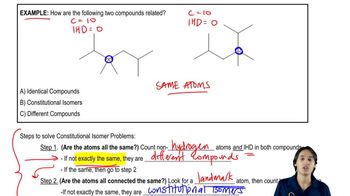
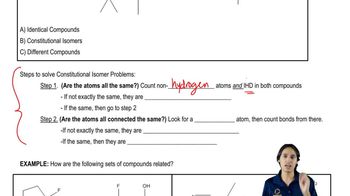
    First, check if the molecules have the same molecular formula by counting non-hydrogen atoms and calculating the Index of Hydrogen Deficiency (IHD). If both match, compare the connectivity of atoms; if the connectivity differs, they are constitutional isomers.
  • What is the difference between constitutional isomers and identical compounds?
    Constitutional isomers have the same molecular formula but different connectivity of atoms, while identical compounds have both the same molecular formula and the same connectivity.
  • What is the role of the Index of Hydrogen Deficiency (IHD) in identifying constitutional isomers?
    IHD helps determine if two molecules have the same number of hydrogens, which is part of confirming they have the same molecular formula before checking for differences in connectivity.
  • How do you identify a 'landmark atom' when comparing two molecules for constitutional isomerism?
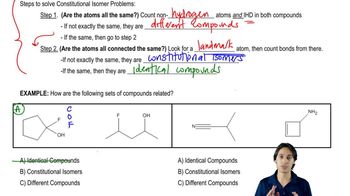
    A landmark atom is an atom or group that stands out, such as an oxygen or a ring, which can be used to compare the position and connectivity in both molecules to help determine if they are constitutional isomers.
  • What is the relationship between butane and isobutane?
    Butane and isobutane are constitutional isomers because they have the same molecular formula (C4H10) but different connectivity of their carbon atoms.
  • How many constitutional isomers are possible for a molecule with the formula C2H4Cl2?
    There are three constitutional isomers possible for C2H4Cl2, differing in the positions of the chlorine atoms on the carbon chain.
  • How many constitutional isomers exist for C5H12?
    There are three constitutional isomers for C5H12: n-pentane, isopentane (methylbutane), and neopentane (dimethylpropane).
  • How many constitutional isomers are possible for C6H14?
    There are five constitutional isomers for C6H14, each with different connectivity of the carbon atoms.
  • What is a constitutional isomer of C8H18?
    Any compound with the formula C8H18 but a different connectivity of carbon atoms than n-octane is a constitutional isomer, such as 2,2,4-trimethylpentane.
  • What is the difference between butyne and cyclobutyne in terms of constitutional isomerism?
    Butyne and cyclobutyne are constitutional isomers because they have the same molecular formula but different connectivity: butyne is a linear alkyne, while cyclobutyne is a cyclic alkyne.
  • How do you determine if two compounds are constitutional isomers, cis-trans isomers, or the same molecule?
    Check if they have the same molecular formula and IHD. If connectivity differs, they are constitutional isomers; if only spatial arrangement differs, they are cis-trans isomers; if both formula and connectivity are the same, they are the same molecule.
  • What is the relationship between glucose and its structural isomers?
    Structural (constitutional) isomers of glucose have the same molecular formula (C6H12O6) but different connectivity of atoms, such as fructose.
  • How many constitutional isomers are possible for C2Cl3F3?
    The number of constitutional isomers for C2Cl3F3 depends on the possible arrangements of Cl and F atoms on the two carbons, with each unique connectivity representing a different isomer.
  • How many constitutional isomers are possible for C2H3Cl3?
    The number of constitutional isomers for C2H3Cl3 is determined by the different possible arrangements of the three chlorine atoms on the two carbons.
  • How do you identify constitutional isomers among a group of hydrocarbons?
    Compare the molecular formulas and connectivity of atoms; compounds with the same formula but different connectivity are constitutional isomers.
  • What is the relationship between n-butane and cyclobutane?
    n-Butane and cyclobutane are constitutional isomers because they have the same molecular formula (C4H8) but different connectivity: n-butane is a straight chain, cyclobutane is a ring.
  • How do you determine if two compounds are identical, constitutional isomers, or different compounds?
    First, check if the molecular formulas and IHD match. If not, they are different compounds. If they match, compare connectivity: if different, they are constitutional isomers; if the same, they are identical.
  • What are the constitutional isomers of C2H6O2?
    Constitutional isomers of C2H6O2 include ethylene glycol (HOCH2CH2OH) and methoxymethanol (CH3OCH2OH), which have the same formula but different connectivity.
  • How do you identify constitutional isomers of butane?
    Constitutional isomers of butane (C4H10) include n-butane and isobutane, which differ in the arrangement of their carbon atoms.
  • What is the process for identifying constitutional isomers among a set of compounds?
    Check if the compounds have the same molecular formula and IHD. If so, compare the connectivity of atoms; different connectivity indicates constitutional isomers.
  • How do you determine the number of constitutional isomers for a given molecular formula?
    List all possible unique connectivities of the atoms that fit the molecular formula; each distinct arrangement is a constitutional isomer.
  • What is the difference between constitutional isomers and stereoisomers?
    Constitutional isomers differ in the connectivity of atoms, while stereoisomers have the same connectivity but differ in the spatial arrangement of atoms.
  • What is the definition of a structural isomer in organic chemistry?
    A structural isomer, also called a constitutional isomer, is a compound with the same molecular formula as another but with a different connectivity of atoms.