Skip to main content
Organic Chemistry
My Course
Learn
Exam Prep
AI Tutor
Study Guides
Textbook Solutions
Flashcards
Explore
Try the app
My Course
Learn
Exam Prep
AI Tutor
Study Guides
Textbook Solutions
Flashcards
Explore
Try the app
Back
Cope Elimination definitions
You can tap to flip the card.
Cope Elimination
You can tap to flip the card.
👆
Cope Elimination
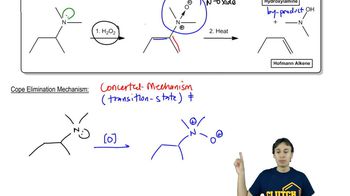
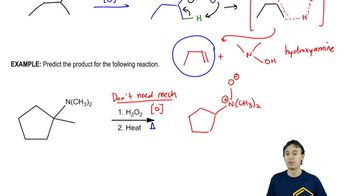
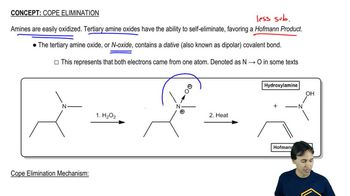
A concerted reaction where a tertiary amine oxide forms a less substituted alkene and hydroxylamine upon heating.
Track progress
Control buttons has been changed to "navigation" mode.
1/13
Related flashcards
Related practice
Recommended videos
Cope Elimination quiz
Cope Elimination
15 Terms
Cope Elimination
26. Amines
4 problems
Topic
Laura
Hofmann Elimination
26. Amines
2 problems
Topic
Johnny
23. Amines - Part 1 of 3
4 topics
11 problems
Chapter
Nicole
23. Amines - Part 2 of 3
5 topics
13 problems
Chapter
Nicole
26. Amines - Part 3 of 3
1 topic
3 problems
Chapter
04:09
General Reaction
1516
views
8
rank
1
comments
04:24
Mechanism
1427
views
7
rank
3
comments
04:20
Predict the Product
1453
views
8
rank
1
comments
Terms in this set (13)
Hide definitions
Cope Elimination
A concerted reaction where a tertiary amine oxide forms a less substituted alkene and hydroxylamine upon heating.
Tertiary Amine Oxide
A compound with a nitrogen atom bonded to three carbons and an oxygen, featuring a dipolar covalent bond.
N-Oxide
A molecule with an oxygen atom directly attached to nitrogen, often formed by oxidation of amines.
Hofmann Product
An elimination product that is the less substituted alkene, favored in certain elimination reactions.
Dative Bond
A covalent bond where both electrons are donated by one atom, resulting in a dipolar charge separation.
Dipolar Covalent Bond
A bond with separated positive and negative charges due to unequal electron sharing between atoms.
Oxidizing Agent
A substance, such as hydrogen peroxide or O2, that facilitates the oxidation of amines to N-oxides.
Hydroxylamine
A byproduct of the Cope elimination, consisting of a nitrogen atom bonded to an OH group and two alkyl groups.
Concerted Mechanism
A reaction pathway where bond breaking and forming occur simultaneously in a single step.
Transition State
A high-energy, short-lived arrangement of atoms where old bonds are partially broken and new bonds are partially formed.
Double Dagger
A symbol (‡) used to denote the transition state in a reaction mechanism.
Hydrogen Peroxide
A weak oxidizing agent commonly used to convert amines into N-oxides.
Zaitsev Product
A more substituted alkene formed in elimination reactions, contrasted with the Hofmann product.
 BackBack


 04:09
04:09