Skip to main content
Organic Chemistry
My Course
Learn
Exam Prep
AI Tutor
Study Guides
Textbook Solutions
Flashcards
Explore
Try the app
My Course
Learn
Exam Prep
AI Tutor
Study Guides
Textbook Solutions
Flashcards
Explore
Try the app
Back
Cope Elimination quiz
You can tap to flip the card.
What type of compound undergoes the Cope elimination reaction?
You can tap to flip the card.
👆
What type of compound undergoes the Cope elimination reaction?
Tertiary amine oxides (N-oxides) undergo the Cope elimination reaction.
Track progress
Control buttons has been changed to "navigation" mode.
1/15
Related flashcards
Related practice
Recommended videos
Cope Elimination definitions
Cope Elimination
13 Terms
Cope Elimination
26. Amines
4 problems
Topic
Laura
Hofmann Elimination
26. Amines
2 problems
Topic
Johnny
23. Amines - Part 1 of 3
4 topics
11 problems
Chapter
Nicole
23. Amines - Part 2 of 3
5 topics
13 problems
Chapter
Nicole
26. Amines - Part 3 of 3
1 topic
3 problems
Chapter
04:09
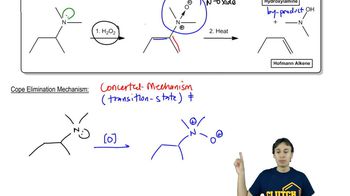
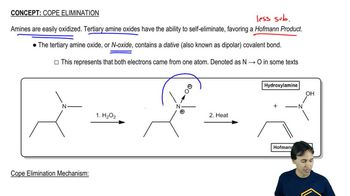
General Reaction
1516
views
8
rank
1
comments
04:24
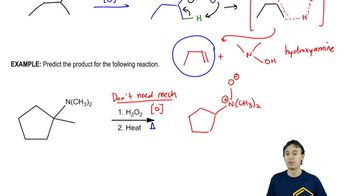
Mechanism
1427
views
7
rank
3
comments
04:20
Predict the Product
1452
views
8
rank
1
comments
Terms in this set (15)
Hide definitions
What type of compound undergoes the Cope elimination reaction?
Tertiary amine oxides (N-oxides) undergo the Cope elimination reaction.
What is the main product formed in a Cope elimination?
The main product is a Hofmann alkene, which is the less substituted elimination product.
What is the byproduct of the Cope elimination reaction?
The byproduct is hydroxylamine, specifically an N-methyl methyl hydroxylamine.
What type of mechanism does the Cope elimination follow?
It follows a concerted mechanism, meaning all bond changes occur in a single step via a transition state.
What is a dative or dipolar covalent bond in the context of amine oxides?
It is a covalent bond where nitrogen donates a lone pair to oxygen, resulting in separated positive and negative charges.
How can tertiary amine oxides be formed in the laboratory?
They can be formed by oxidizing tertiary amines with weak oxidizing agents like hydrogen peroxide or even atmospheric oxygen.
What does the term 'N-oxide' refer to?
It refers to a structure where an oxygen atom is directly bonded to a nitrogen atom in a tertiary amine.
Why is the Hofmann product favored in the Cope elimination?
Because the elimination occurs at the least substituted position, leading to the less substituted alkene.
What is the role of heat in the Cope elimination?
Heat is required to initiate the self-elimination of the N-oxide, driving the reaction forward.
How is the transition state in the Cope elimination depicted?
It is shown with partial (dotted) bonds indicating simultaneous bond breaking and forming, and is enclosed in brackets with a double dagger symbol.
What happens to the N–O bond during the Cope elimination?
The N–O bond remains intact during the transition state and is part of the concerted elimination process.
What is the difference between the Zaitsev and Hofmann products?
The Zaitsev product is the more substituted alkene, while the Hofmann product is the less substituted alkene.
What is the significance of the positive and negative charges in the N-oxide structure?
The nitrogen carries a positive charge and the oxygen a negative charge, reflecting the dipolar nature of the bond.
Can the Cope elimination occur with primary or secondary amines?
No, it specifically requires tertiary amine oxides for the reaction to proceed.
What is the first step in the Cope elimination mechanism?
The first step is the oxidation of a tertiary amine to form the corresponding N-oxide.
 BackBack


 04:09
04:09