Organic Chemistry
My Course
Learn
Exam Prep
AI Tutor
Study Guides
Textbook Solutions
Flashcards
Explore
Try the app
My Course
Learn
Exam Prep
AI Tutor
Study Guides
Textbook Solutions
Flashcards
Explore
Try the app
Back
Cyanohydrin definitions
You can tap to flip the card.
Cyanohydrin
You can tap to flip the card.
👆
Cyanohydrin
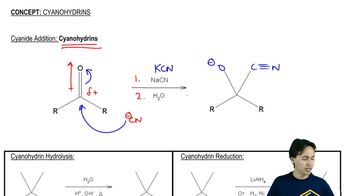
A functional group with a CN and an OH on adjacent carbons, formed by nucleophilic addition of cyanide to a carbonyl.
Track progress
Control buttons has been changed to "navigation" mode.
1/15
Related flashcards
Related practice
Recommended videos
Cyanohydrin quiz
Cyanohydrin
15 Terms
19. Aldehydes and Ketones:Nucleophilic Addition - Part 1 of 3
5 topics
14 problems
Chapter
Johnny
19. Aldehydes and Ketones:Nucleophilic Addition - Part 2 of 3
1 topic
13 problems
Chapter
Johnny
19. Aldehydes and Ketones:Nucleophilic Addition - Part 3 of 3
2 topics
13 problems
Chapter
Ernest
Guided course
02:36
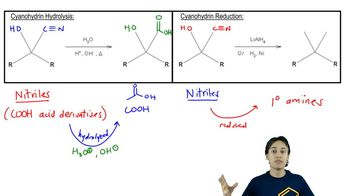
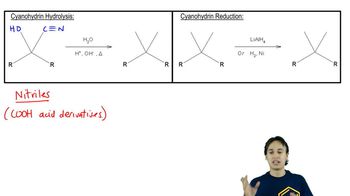
Nitrile Reduction
2434
views
14
rank
1
comments
Guided course
02:22
Nitrile Hydrolysis
2404
views
19
rank
4
comments
Guided course
03:53
Addition of Cyanide
2613
views
24
rank
7
comments
Terms in this set (15)
Hide definitions
Cyanohydrin
A functional group with a CN and an OH on adjacent carbons, formed by nucleophilic addition of cyanide to a carbonyl.
Nucleophilic Addition
A reaction where a nucleophile attacks an electrophilic carbon, commonly seen with cyanide attacking carbonyls.
Cyanide
A negatively charged nucleophile, often from NaCN or KCN, that adds to carbonyls to form cyanohydrins.
Sodium Cyanide
A common laboratory source of cyanide ions, used to generate cyanohydrins from carbonyl compounds.
Potassium Cyanide
A salt providing cyanide ions for nucleophilic addition reactions, similar in use to sodium cyanide.
Hydrogen Cyanide
A compound supplying both cyanide and a proton, enabling cyanohydrin formation in a single step.
Nitrile
A functional group containing a carbon triple-bonded to nitrogen, present in cyanohydrins and carboxylic acid derivatives.
Carboxylic Acid Derivative
A molecule that can be hydrolyzed to a carboxylic acid, including nitriles found in cyanohydrins.
Hydrolysis
A reaction using acid or base and water to convert nitriles into carboxylic acids, leaving alcohol groups unchanged.
Reduction
A process converting nitriles into primary amines, typically using lithium aluminum hydride or catalytic hydrogenation.
Lithium Aluminum Hydride
A strong reducing agent capable of converting nitriles to primary amines by breaking triple bonds.
Catalytic Hydrogenation
A reduction method using metals like nickel, palladium, or platinum to convert nitriles to amines.
Primary Amine
A product of nitrile reduction, featuring a CH2NH2 group derived from the original CN group.
Protonation
A step following nucleophilic addition where a negatively charged intermediate gains a proton, often from water or acid.
Partial Positive Charge
An electron-deficient site, such as the carbon in a carbonyl, making it susceptible to nucleophilic attack.