Back

Cyanohydrin quiz

Control buttons has been changed to "navigation" mode.
1/15
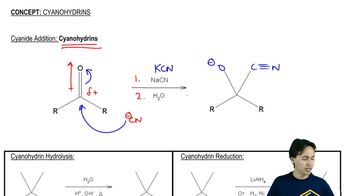
  • What functional group is formed when cyanide attacks a carbonyl in a nucleophilic addition reaction?

    A cyanohydrin is formed, which contains a CN and an OH group on adjacent carbons.
  • What are two common sources of cyanide ion (CN-) used in cyanohydrin formation?

    Sodium cyanide (NaCN) and potassium cyanide (KCN) are commonly used sources of CN-.
  • What is the advantage of using hydrogen cyanide (HCN) in cyanohydrin synthesis?

    HCN provides both the CN- for nucleophilic addition and the proton needed for protonation, combining both steps in one reagent.
  • What is the typical mechanism for cyanohydrin formation from a carbonyl compound?

    CN- attacks the carbonyl carbon, forming an alkoxide intermediate, which is then protonated to yield the cyanohydrin.
  • What is the functional group name for the CN group in cyanohydrins?

    The CN group is called a nitrile.
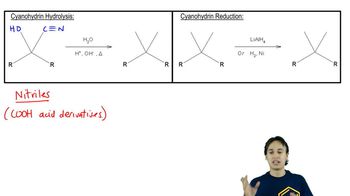
  • To which category of molecules do nitriles belong?

    Nitriles are carboxylic acid derivatives.
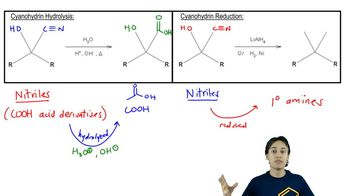
  • What happens to a cyanohydrin when it undergoes hydrolysis?

    The nitrile group is converted to a carboxylic acid, while the alcohol group remains unchanged.
  • What conditions are required to hydrolyze a nitrile group in a cyanohydrin?

    Hydrolysis can be achieved using acid and water or base and heat.
  • What is the product when a cyanohydrin’s nitrile group is reduced?

    The nitrile group is reduced to a primary amine, specifically CH2NH2.
  • Name two types of reducing agents that can convert a nitrile to a primary amine.

    Lithium aluminum hydride (LiAlH4) and catalytic hydrogenation with metals like nickel, palladium, or platinum.
  • Why is it important to remember the carbon atom in the CN group during reduction?

    Because the product should be CH2NH2, not just NH2; the carbon from the CN group remains in the amine.
  • Does the alcohol group in a cyanohydrin change during reduction of the nitrile group?

    No, the alcohol group remains unchanged during reduction.
  • What is the pKa of HCN and why is it relevant in cyanohydrin formation?

    HCN has a pKa of about 10, making it acidic enough to ionize in aqueous environments and provide CN-.
  • What mistake do students often make when drawing the product of nitrile reduction?

    They sometimes forget the carbon atom and draw NH2 instead of CH2NH2 as the product.
  • What is the relationship between cyanohydrins and carboxylic acid derivatives?

    Cyanohydrins contain a nitrile group, which is a carboxylic acid derivative and can be hydrolyzed to a carboxylic acid.