How do you determine the degree of unsaturation (index of hydrogen deficiency, IHD) for a given molecule?
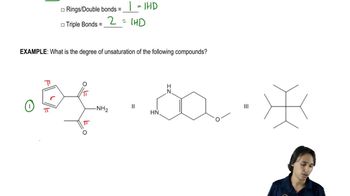
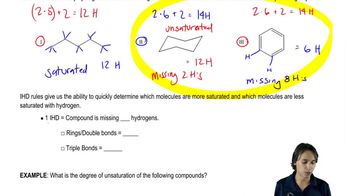
To determine the degree of unsaturation (IHD) for a molecule, use either the structural method (counting rings and pi bonds: each ring or double bond counts as 1 IHD, each triple bond as 2 IHD) or the molecular formula method: calculate the maximum number of hydrogens for a saturated molecule (2n+2, where n is the number of carbons), adjust for other atoms (add halogens as hydrogens, ignore oxygens, subtract one hydrogen for each nitrogen), subtract the actual number of hydrogens (and equivalents), and divide the difference by 2.
What defines a molecule as unsaturated in organic chemistry?
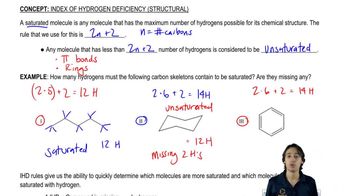
A molecule is considered unsaturated if it contains fewer hydrogens than the maximum possible for its number of carbons (2n+2), which occurs due to the presence of rings or pi bonds (double or triple bonds).
How many degrees of unsaturation does a carbon-carbon triple bond contribute to a molecule?
A carbon-carbon triple bond contributes 2 degrees of unsaturation (IHD) to a molecule.
What is the general formula for calculating the index of hydrogen deficiency (IHD) from a molecular formula?
The general formula for IHD is: IHD = [(2n + 2) - (number of hydrogens + number of halogens - number of nitrogens)] / 2, where n is the number of carbons. Oxygen atoms are ignored in this calculation.
Describe the steps to calculate the degree of unsaturation (DU) for any organic molecule given its molecular formula.
To calculate the degree of unsaturation (DU): 1) Count the number of carbons (n). 2) Calculate the maximum hydrogens for a saturated molecule (2n+2). 3) Add the number of halogens to the hydrogen count. 4) Subtract one hydrogen for each nitrogen. 5) Ignore oxygens. 6) Subtract the actual hydrogen (and equivalent) count from the maximum. 7) Divide the result by 2.
How do you determine the unsaturation number (degree of unsaturation) for multiple compounds using their molecular formulas?
For each compound, apply the IHD formula: IHD = [(2n + 2) - (number of hydrogens + number of halogens - number of nitrogens)] / 2, ignoring oxygens. Repeat this process for each molecular formula to find the unsaturation number for each compound.
Why does the formation of a ring in a carbon chain reduce the number of hydrogens in a molecule?
Forming a ring causes the terminal carbons to fuse, which means each loses a hydrogen compared to an open chain. This reduction in hydrogens contributes to the molecule's degree of unsaturation.
How does the concept of IHD help compare the relative unsaturation of different molecules?
IHD provides a numerical value indicating how many pairs of hydrogens are missing due to rings or pi bonds. A higher IHD means a molecule is more unsaturated than one with a lower IHD.
What role do halogens play when calculating the index of hydrogen deficiency from a molecular formula?
Halogens are counted as equivalent to one hydrogen atom in the IHD calculation. This adjustment ensures the formula accurately reflects the molecule's unsaturation.
Why is oxygen ignored when determining the degree of unsaturation using a molecular formula?
Oxygen does not affect the number of hydrogens needed for saturation in the IHD calculation. Therefore, it is excluded from the formula to simplify the process.