Back

Diazo Replacement Reactions quiz

Control buttons has been changed to "navigation" mode.
1/15
  • What reagent is used to convert aniline into a diazonium salt in diazotization?

    Nitrous acid (NaNO2 over HCl) is used to convert aniline into a diazonium salt.
  • What is the structure of a diazo group formed during diazotization?

    A diazo group is an N≡N⁺ group, also called N2 positive, attached to the aromatic ring.
  • Which reagent is used to replace a diazo group with a bromine atom on benzene?

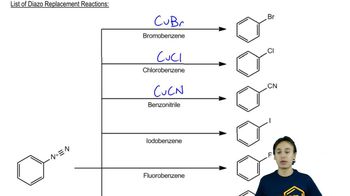
    CuBr is used to replace the diazo group with a bromine atom, forming bromobenzene.
  • What reagent replaces the diazo group with a chlorine atom on benzene?

    CuCl is used to replace the diazo group with a chlorine atom, forming chlorobenzene.
  • How is benzonitrile formed from a diazonium salt?

    Reacting the diazonium salt with CuCN replaces the diazo group with a CN group, forming benzonitrile.
  • Which reagent is used to form iodobenzene from a diazonium salt?

    KI is used to replace the diazo group with an iodine atom, forming iodobenzene.
  • What is the only way to synthesize fluorobenzene in organic chemistry using diazo replacement?

    Fluorobenzene is synthesized by reacting the diazonium salt with HBF4, which replaces the diazo group with fluorine.
  • How can phenol be formed from a diazonium salt?

    Phenol can be formed by simply reacting the diazonium salt with water, replacing the diazo group with an OH group.
  • What alternative, more complicated reagent can also convert a diazonium salt to phenol?

    Cu2O, Cu2+ and water can be used, but most professors accept just water for this conversion.
  • Which reagent removes the diazo group and restores benzene to its original form?

    H3PO2 is used to remove the diazo group and replace it with a hydrogen atom, regenerating benzene.
  • What is an azo dye and how is it formed in diazo replacement reactions?

    An azo dye is a compound with an N=N double bond formed by coupling a diazonium salt with another benzene ring containing an electron-donating group.
  • Why are azo dyes highly colored?

    Azo dyes are highly colored because their structures are highly conjugated, allowing them to absorb visible light and display vivid colors.
  • What type of benzene ring is required for azo coupling with a diazonium salt?

    A benzene ring with an activating or electron-donating group is required for azo coupling with a diazonium salt.
  • Why is diazotization important in organic synthesis?

    Diazotization expands the range of functionalized arenes accessible, allowing synthesis of phenols, fluorobenzenes, and azo dyes, which are not easily made by EAS.
  • What is the main advantage of using diazo replacement reactions in aromatic chemistry?

    Diazo replacement reactions allow for versatile substitution on aromatic rings, including groups not accessible by electrophilic aromatic substitution.