Back

DIBAL quiz

Control buttons has been changed to "navigation" mode.
1/15
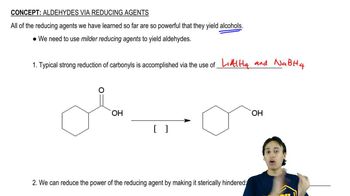
  • What is the typical product when strong reducing agents like lithium aluminum hydride (LAH) or sodium borohydride react with carbonyl compounds?

    The typical product is an alcohol, as these strong reducing agents add two equivalents of hydrogen to the carbonyl.
  • Why would you use a milder reducing agent instead of LAH or sodium borohydride when reducing a carbonyl?

    A milder reducing agent is used to stop at the aldehyde stage, adding only one equivalent of hydrogen instead of two.
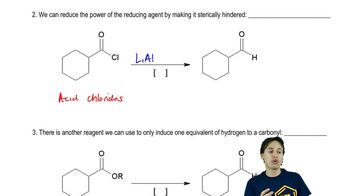
  • What is the main structural difference between LAH and its sterically hindered version used for reducing acid chlorides?

    The sterically hindered version replaces three hydrogens with tert-butoxy groups, leaving only one reactive hydrogen.
  • Which functional group does the sterically hindered version of LAH specifically reduce to an aldehyde?

    It specifically reduces acid chlorides to aldehydes.
  • What is the purpose of adding tert-butoxy groups to LAH?

    Adding tert-butoxy groups increases steric hindrance, making the reagent less reactive and selective for adding only one equivalent of hydrogen.
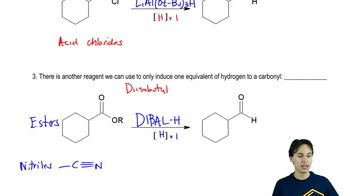
  • What is DIBAL-H and what does its name stand for?

    DIBAL-H stands for diisobutylaluminum hydride, a milder reducing agent.
  • Which functional groups does DIBAL-H selectively reduce to aldehydes?

    DIBAL-H selectively reduces esters and nitriles to aldehydes.
  • How many equivalents of hydrogen does DIBAL-H add during reduction?

    DIBAL-H adds only one equivalent of hydrogen to the substrate.
  • Why is DIBAL-H considered sterically hindered?

    DIBAL-H is sterically hindered due to the presence of two bulky isobutyl groups attached to the aluminum atom.
  • What additional step is required after reduction with DIBAL-H to obtain the final aldehyde product?

    A hydrolysis step with water is required to convert the intermediate into the final aldehyde.
  • What is the structure of DIBAL-H?

    DIBAL-H consists of an aluminum atom bonded to two isobutyl groups and one hydrogen.
  • What is the key feature that allows DIBAL-H to stop at the aldehyde stage instead of reducing all the way to an alcohol?

    Its steric hindrance and mild reactivity prevent it from adding more than one equivalent of hydrogen.
  • What must students memorize about these milder reducing agents?

    Students must memorize their structures and the specific functional groups they convert to aldehydes.
  • What is the product when DIBAL-H reduces a nitrile?

    The product is an aldehyde after hydrolysis.
  • How does the reactivity of DIBAL-H compare to LAH?

    DIBAL-H is less reactive than LAH due to its steric hindrance, making it selective for partial reduction.