Back

Dihydroxylation definitions

Control buttons has been changed to "navigation" mode.
1/14
  • Dihydroxylation

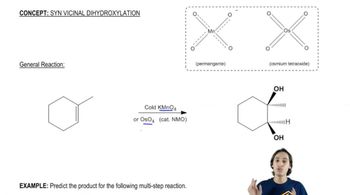
    An addition process introducing two hydroxyl groups across a double bond, yielding a diol with specific stereochemistry.
  • Syn Addition

    A process where two substituents are added to the same side of a double bond, resulting in a cis product.
  • Vicinal Diol

    A molecule featuring two hydroxyl groups attached to adjacent carbon atoms, often formed from alkene reactions.
  • Potassium Permanganate

    A strong oxidizing agent, often depicted as a 'UFO,' used to add oxygen atoms to double bonds in organic synthesis.
  • Osmium Tetroxide

    A reagent with a central metal surrounded by oxygens, facilitating syn addition of hydroxyl groups to alkenes.
  • Double Bond

    A region of high electron density between two carbons, serving as a reactive site for addition reactions.
  • Cyclization

    A mechanistic step where a ring intermediate forms as a reagent interacts with a double bond.
  • Catalytic NMO

    A catalyst sometimes used with osmium tetroxide to regenerate the active oxidant during dihydroxylation.
  • Cis Configuration

    A spatial arrangement where two groups are on the same side of a reference plane, often resulting from syn addition.
  • Alcohol Group

    A functional group consisting of an -OH moiety, introduced to alkenes during dihydroxylation.
  • Oxidizing Agent

    A substance capable of transferring oxygen atoms to other molecules, crucial in addition reactions to alkenes.
  • Cyclic Intermediate

    A transient ring structure formed during the initial step of the dihydroxylation mechanism.
  • Mechanism

    A sequence of steps describing how reactants are converted to products, with emphasis on key intermediates.
  • Reagent

    A chemical species introduced to drive a specific transformation, such as adding hydroxyl groups to a double bond.