Back

Dihydroxylation quiz

Control buttons has been changed to "navigation" mode.
1/15
  • What is syn vicinal dihydroxylation?

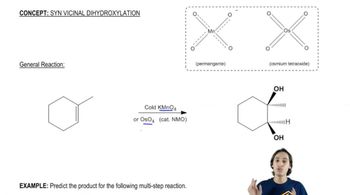
    It is an addition reaction that adds two alcohol groups to the same double bond in a syn (cis) and vicinal (adjacent) fashion.
  • Which two reagents are commonly used for syn vicinal dihydroxylation?

    Potassium permanganate (KMnO4) and osmium tetroxide (OsO4) are commonly used.
  • What is the product of syn vicinal dihydroxylation called?

    The product is called a diol, specifically a vicinal diol.
  • What does 'vicinal' mean in the context of diols?

    Vicinal means that the two alcohol groups are on adjacent (neighboring) carbons.
  • What does 'syn' mean in the context of this reaction?

    Syn means that both alcohol groups are added to the same side (cis) of the double bond.
  • Do you need to know the full mechanism of syn vicinal dihydroxylation for exams?

    No, you only need to know the first step and the overall result, not the full mechanism.
  • What is the first step in the mechanism when using OsO4?

    The first step is a cyclization reaction where the double bond reacts with an oxygen atom from OsO4 to form a cyclic intermediate.
  • What happens to the OsO4 reagent after the reaction?

    OsO4 loses two oxygens and leaves, no longer part of the final product.
  • What is the role of NMO in this reaction?

    NMO can be used as a catalyst, but it is not always present and is not essential to remember for the basic reaction.
  • How many alcohol groups are added to the double bond in this reaction?

    Two alcohol groups are added, one to each carbon of the original double bond.
  • What is a metaphor used to describe KMnO4 and OsO4 in the lesson?

    They are described as UFOs or flying saucers that 'attack' double bonds and add oxygens.
  • Is the addition of alcohol groups in this reaction anti or syn?

    The addition is syn, meaning both groups are added to the same side.
  • What is left behind after the 'UFO' reagents react with the double bond?

    A vicinal diol (two adjacent alcohols) is left behind.
  • Why is it important to recognize the final product of this reaction?

    Because understanding the final product helps you predict the outcome without memorizing the full mechanism.
  • What should students focus on learning for syn vicinal dihydroxylation?

    Students should focus on recognizing the reagents, the syn addition, and the structure of the final diol product.