Back

Directed Condensations definitions

Control buttons has been changed to "navigation" mode.
1/14
  • Aldol Condensation

    A reaction where an enolate attacks an electrophilic carbonyl, forming a β-hydroxy carbonyl compound.
  • Asymmetrical Ketone

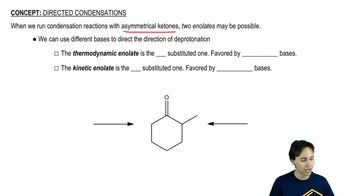
    A molecule with two different groups attached to the carbonyl carbon, allowing formation of two distinct enolates.
  • Enolate

    A resonance-stabilized anion formed by deprotonation of a carbon adjacent to a carbonyl group.
  • Directed Reaction

    A process used to selectively generate a specific enolate from a molecule with multiple possible sites.
  • Thermodynamic Enolate

    The more substituted, stable enolate formed under equilibrium conditions, favored by small bases.
  • Kinetic Enolate

    The less substituted, rapidly formed enolate favored by bulky bases and low temperatures.
  • Thermodynamic Control

    A condition where product distribution is determined by relative stability, typically using small bases.
  • Kinetic Control

    A condition where product distribution is determined by the rate of formation, typically using bulky bases.
  • Small Base

    A reagent like NaOH that can access more hindered positions, favoring formation of the more substituted enolate.
  • Bulky Base

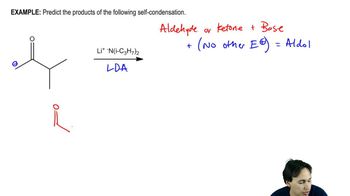
    A large, sterically hindered base such as LDA, favoring deprotonation at less hindered positions.
  • LDA

    A non-nucleophilic, bulky base commonly used to generate kinetic enolates selectively.
  • Tert Butoxide

    A bulky base that can also be used to favor formation of kinetic enolates by deprotonating less hindered sites.
  • Non-nucleophilic Base

    A base that removes protons without adding to electrophilic centers, preventing side reactions.
  • Electrophile

    A species with an electron-deficient center that reacts with nucleophiles like enolates.