Back

Directed Condensations quiz

Control buttons has been changed to "navigation" mode.
1/15
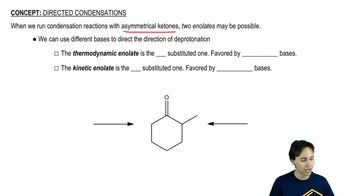
  • Why are directed reactions necessary when working with asymmetrical ketones in enolate chemistry?

    Directed reactions are necessary because asymmetrical ketones can form two different enolates, and we need to select which enolate will react with the electrophile.
  • What is the thermodynamic enolate?

    The thermodynamic enolate is the more substituted enolate, which is favored under thermodynamic control using small bases.
  • What type of base favors the formation of the thermodynamic enolate?

    Small bases, such as NaOH, favor the formation of the thermodynamic (more substituted) enolate.
  • What is the kinetic enolate?

    The kinetic enolate is the less substituted enolate, which forms more quickly and is favored by bulky bases.
  • Which type of base is used to favor the kinetic enolate?

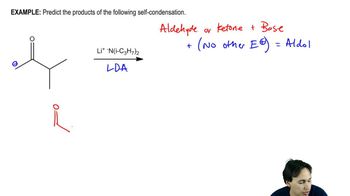
    Bulky bases, such as LDA (Lithium Diisopropylamide), are used to favor the formation of the kinetic enolate.
  • Why is LDA a popular base for forming kinetic enolates?

    LDA is popular because it is a bulky, non-nucleophilic base that efficiently removes a hydrogen without adding to the substrate.
  • What is the role of base size in directing enolate formation?

    Base size determines which enolate forms: small bases favor the more substituted (thermodynamic) enolate, while bulky bases favor the less substituted (kinetic) enolate.
  • What happens if you use a small base like NaOH in an aldol reaction with an asymmetrical ketone?

    Using a small base like NaOH will favor the formation of the more substituted (thermodynamic) enolate.
  • What happens if you use a bulky base like LDA in an aldol reaction with an asymmetrical ketone?

    Using a bulky base like LDA will favor the formation of the less substituted (kinetic) enolate.
  • Why is it important to control which enolate forms in a reaction with an asymmetrical ketone?

    Controlling which enolate forms ensures that the reaction occurs at the desired position on the ketone, leading to the desired product.
  • What is another bulky base, besides LDA, that can be used to form kinetic enolates?

    Tert-butoxide is another bulky base that can be used to favor kinetic enolate formation.
  • What is the main concern when using a nucleophilic base in enolate chemistry?

    A nucleophilic base might add to the substrate instead of just removing a hydrogen, leading to unwanted side reactions.
  • How does thermodynamic control affect enolate formation?

    Thermodynamic control allows the system to reach the most stable (more substituted) enolate, usually with small bases and longer reaction times.
  • How does kinetic control affect enolate formation?

    Kinetic control favors the fastest-forming (less substituted) enolate, typically using bulky bases and lower temperatures.
  • What is the purpose of using directed condensations in organic synthesis?

    Directed condensations allow chemists to selectively form a specific enolate and control the outcome of reactions involving asymmetrical ketones.