When a double bond joins two carbon atoms, what type of bond can form through double elimination reactions?
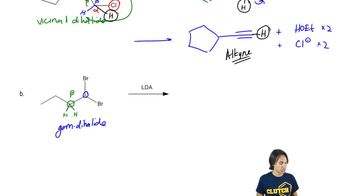
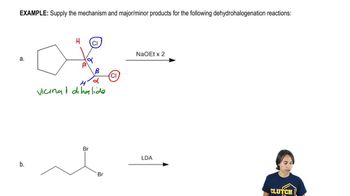
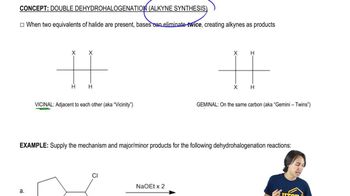
A triple bond (alkyne) can form when a double bond joins two carbon atoms through double dehydrohalogenation (double elimination) of a dihalide with two equivalents of base.
What is the key difference between vicinal and geminal dihalides in terms of halogen placement?
Vicinal dihalides have halogens on adjacent carbons (1,2 relationship), while geminal dihalides have both halogens on the same carbon (1,1 relationship). This distinction helps identify substituent positions in organic molecules.
How many equivalents of base are required for double dehydrohalogenation of a dihalide?
Two equivalents of base are needed for double dehydrohalogenation. This allows the reaction to occur twice, forming an alkyne.
What mnemonic can help you remember the meaning of 'vicinal' in organic chemistry?
The word 'vicinal' is related to 'vicinity,' meaning close by. This helps recall that vicinal substituents are on adjacent carbons.
Why is the term 'geminal' associated with twins in organic chemistry?
'Geminal' sounds like 'Gemini,' which means twins, indicating both substituents are on the same carbon. This association helps remember the 1,1 relationship.
Can both vicinal and geminal dihalides undergo double dehydrohalogenation to form alkynes?
Yes, both vicinal and geminal dihalides can react with two equivalents of base to form alkynes. The reaction mechanism applies to both types of dihalides.
What type of bond is formed after double dehydrohalogenation of a dihalide?
A triple bond, or alkyne, is formed after double dehydrohalogenation. This process converts the original dihalide into an alkyne.
What general term describes the process of removing two halogens from a dihalide using base?
The process is called double dehydrohalogenation. It involves two elimination reactions to remove both halogens.
Are the terms 'vicinal' and 'geminal' exclusive to dihalides in organic chemistry?
No, 'vicinal' and 'geminal' are general position words used for various substituents, not just dihalides. They help describe the relative locations of groups on a molecule.
What is the relationship between the terms 'terminal' and 'internal' and the words 'vicinal' and 'geminal'?
'Terminal' and 'internal' are also position words like 'vicinal' and 'geminal' in organic chemistry. They all help identify where substituents are located on a molecule.
 Back
Back

 02:20
02:20