Organic Chemistry
My Course
Learn
Exam Prep
AI Tutor
Study Guides
Textbook Solutions
Flashcards
Explore
My Course
Learn
Exam Prep
AI Tutor
Study Guides
Textbook Solutions
Flashcards
Explore
Back
Drawing Atomic Orbitals quiz
You can tap to flip the card.
Define:
What is the first rule for drawing atomic orbitals in a conjugated molecule?
You can tap to flip the card.
👆
What is the first rule for drawing atomic orbitals in a conjugated molecule?
The number of atomic orbitals equals the number of conjugated atoms in the molecule.
Track progress
Control buttons has been changed to "navigation" mode.
1/15
Related flashcards
Related practice
Recommended videos
Drawing Atomic Orbitals definitions
Drawing Atomic Orbitals
14 Terms
Drawing Molecular Orbitals
16. Conjugated Systems
3 problems
Topic

Johnny
16. Conjugated Systems - Part 1 of 3
4 topics
15 problems
Chapter
Johnny
16. Conjugated Systems - Part 2 of 3
6 topics
14 problems
Chapter
Johnny
16. Conjugated Systems - Part 3 of 3
6 topics
14 problems
Chapter
Johnny
Guided course
02:43
Two Rules of Drawing Atomic Orbitals
Johnny Betancourt
1550
views
12
rank
4
comments
Guided course
01:43
Supply Atomic Orbitals
Johnny Betancourt
1383
views
8
rank
1
comments
Guided course
01:11
Supply Atomic Orbitals
Johnny Betancourt
1251
views
5
rank
1
comments
Terms in this set (15)
Hide definitions
What is the first rule for drawing atomic orbitals in a conjugated molecule?
The number of atomic orbitals equals the number of conjugated atoms in the molecule.
How do you determine if an atom in a molecule is conjugated?
An atom is conjugated if it has a nonbonding orbital, such as a lone pair, radical, or pi bond.
How many atomic orbitals should you draw for a molecule with three conjugated atoms?
You should draw three atomic orbitals, one for each conjugated atom.
What type of orbitals do not count as conjugated atoms?
Orbitals that are only attached to atoms and do not have nonbonding electrons do not count as conjugated.
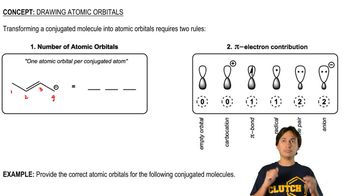
How many electrons do empty orbitals and carbocations contribute to the pi system?
Empty orbitals and carbocations contribute 0 electrons.
How many electrons does a pi bond contribute to the pi system?
A pi bond contributes 1 electron.
How many electrons does a radical contribute to the pi system?
A radical contributes 1 electron.
How many electrons does a lone pair contribute to the pi system?
A lone pair contributes 2 electrons.
How many electrons does an anion contribute to the pi system?
An anion contributes 2 electrons.
What is the process for transforming a conjugated molecule into atomic orbitals?
Count the number of conjugated atoms, draw that many atomic orbitals, and add the number of pi electrons contributed by each.
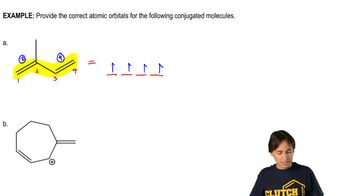
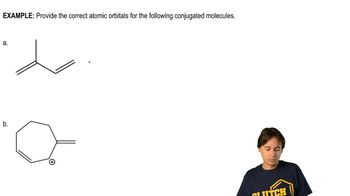
In the example given, why does one atom not count as conjugated?
It only has orbitals attached to atoms and lacks nonbonding orbitals.
What does the presence of an anion indicate about the orbital?
It indicates a lone pair with a negative charge, which is a nonbonding orbital.
What should you do after counting the number of atomic orbitals in a molecule?
Line up the atomic orbitals and add the number of pi electrons each contributes.
Why do lone pairs and anions contribute two electrons each?
Because each contains two electrons in the nonbonding orbital.
What is the significance of nonbonding orbitals in drawing atomic orbitals?
Only atoms with nonbonding orbitals are considered conjugated and are used to determine the number of atomic orbitals to draw.