Back

Drawing Molecular Orbitals definitions

Control buttons has been changed to "navigation" mode.
1/13
  • Atomic Orbital

    A region around a single atom where electrons are likely to be found, serving as the starting point for constructing molecular orbitals.
  • Molecular Orbital

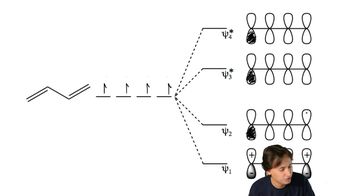
    A region formed by combining atomic orbitals, where electrons are shared across multiple atoms, each with a distinct energy level.
  • Energy Level

    A quantized state indicating the relative energy of an orbital, with higher levels corresponding to more nodes and phase changes.
  • Phase

    A property of an orbital describing the sign or direction of its wave function, which can remain constant or alternate with energy.
  • Node

    A point or plane within an orbital where the probability of finding an electron is zero, increasing in number with higher energy orbitals.
  • Sine Wave

    A mathematical curve used to distribute nodes symmetrically across molecular orbitals, especially in complex arrangements.
  • Electron Configuration

    The arrangement of electrons in molecular orbitals, determined by specific principles to ensure proper filling order.
  • Aufbau Principle

    A rule stating that electrons occupy the lowest available energy orbitals before filling higher ones in a molecule.
  • Pauli Exclusion Principle

    A rule limiting each orbital to a maximum of two electrons, each with opposite spins, ensuring unique quantum states.
  • Hund's Rule

    A guideline requiring electrons to fill degenerate orbitals singly and symmetrically before pairing up.
  • Degenerate Orbital

    An orbital sharing the same energy as others, requiring special filling rules to maintain symmetry.
  • Symmetry

    A spatial property ensuring nodes and electrons are distributed as evenly as possible within molecular orbitals.
  • Orbital Elimination

    The process of removing an orbital intersected by a node, as electrons cannot occupy that region.