Back

Drawing Molecular Orbitals quiz

Control buttons has been changed to "navigation" mode.
1/15
  • What does Rule 1 state about the number of molecular orbitals compared to atomic orbitals?

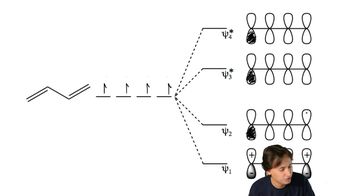
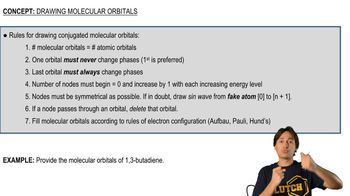
    The number of molecular orbitals should equal the number of atomic orbitals.
  • According to Rule 2, what should be true about one of the molecular orbitals as energy increases?

    One molecular orbital should never change phases as energy increases.
  • What does Rule 3 say about the highest energy molecular orbital?

    The highest energy molecular orbital must always change phases with each increase in energy level.
  • How does the number of nodes change in molecular orbitals according to Rule 4?

    The number of nodes starts at zero and increases by one with each higher energy level.
  • What is the guideline for node placement in Rule 5?

    Nodes should be spaced as symmetrically as possible within the molecular orbital.
  • What tool can you use to help space nodes symmetrically in complex molecular orbitals?

    You can use a sine wave to help balance out nodes evenly in complex arrangements.
  • According to Rule 6, what should you do if a node passes directly through an orbital?

    You must delete that orbital because electrons cannot exist at a node.
  • Which electron configuration rules should you use to fill molecular orbitals as stated in Rule 7?

    You should use the Aufbau principle, Pauli exclusion principle, and Hund's rule.
  • What does the Aufbau principle dictate when filling molecular orbitals?

    The Aufbau principle states that electrons fill the lowest energy orbitals first.
  • How does the Pauli exclusion principle apply to molecular orbitals?

    The Pauli exclusion principle allows only two electrons with opposite spins in each orbital.
  • What does Hund's rule require when filling degenerate molecular orbitals?

    Hund's rule requires that degenerate orbitals be filled one at a time with parallel spins before pairing.
  • Why is it important that the first molecular orbital does not change phase?

    It provides a consistent reference point and simplifies identifying phase changes in higher orbitals.
  • What happens to the number of nodes as you move to higher energy molecular orbitals?

    The number of nodes increases by one with each higher energy molecular orbital.
  • Why should nodes be spaced symmetrically in molecular orbitals?

    Symmetrical spacing of nodes ensures accurate representation of electron distribution and orbital energy.
  • What is the consequence of having a node intersect an atomic orbital in a molecular orbital diagram?

    That atomic orbital is eliminated because electrons cannot occupy a node.