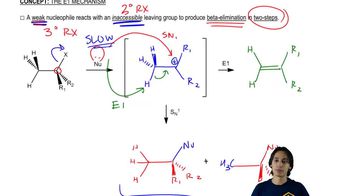
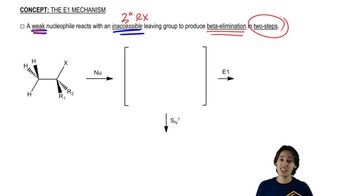
What is the major alkene product formed from a tertiary alkyl halide undergoing an E1 reaction?
The major alkene product formed from a tertiary alkyl halide in an E1 reaction is the most substituted (Zaitsev) alkene. This is because the E1 mechanism proceeds via carbocation formation, allowing for possible rearrangements and favoring elimination of a beta hydrogen that leads to the most stable, highly substituted double bond.
Which statement about the E1 mechanism is incorrect: (a) The rate depends on the nucleophile concentration, (b) The reaction proceeds via a carbocation intermediate, (c) The leaving group departs before elimination, (d) Anticoplanar geometry is required?
Statements (a) and (d) are incorrect for the E1 mechanism. The rate of an E1 reaction does not depend on the nucleophile concentration; it depends on the formation of the carbocation. Additionally, anticoplanar geometry is not required for E1, as the leaving group has already departed before elimination occurs.
Describe the steps and possible products of the E1 reaction of a tertiary alkyl halide.
In the E1 reaction of a tertiary alkyl halide, the first step is the departure of the leaving group, forming a carbocation intermediate. In the second step, a base removes a beta hydrogen, resulting in the formation of an alkene. The reaction can yield multiple alkene products if there are different beta hydrogens available, but the major product is typically the most substituted alkene. Carbocation rearrangements may also occur, leading to more stable products.
Why does a molecule undergo an E1 mechanism when stirred in water?
A molecule undergoes an E1 mechanism when stirred in water because water is a weak nucleophile and can act as a base. E1 reactions are favored by weak nucleophiles and highly substituted (tertiary) leaving groups, which promote carbocation formation followed by elimination to form an alkene.
Why do E1 and SN1 reactions often occur together under the same conditions?
Both E1 and SN1 are favored by weak nucleophiles and highly substituted (tertiary) leaving groups, leading to competition between elimination and substitution. This results in a mixture of products because both mechanisms share the same carbocation intermediate.
What is the rate-determining step in the E1 reaction mechanism?
The rate-determining step in the E1 mechanism is the departure of the leaving group to form a carbocation. This step is slow and controls the overall reaction rate.
How does the presence of multiple beta hydrogens affect the outcome of an E1 reaction?
If multiple beta hydrogens are present, the E1 reaction can produce several different alkene products. The major product is usually the most substituted alkene, but minor products may also form from elimination at other beta positions.
Why are E1 and SN1 reactions considered problematic for synthetic organic chemistry?
E1 and SN1 reactions are problematic because they often yield mixtures of products, including different alkenes and enantiomers. This makes it difficult to isolate a single desired compound for synthesis.
What does the '1' in E1 stand for, and what does it indicate about the reaction kinetics?
The '1' in E1 stands for unimolecular, indicating that the rate of the reaction depends only on the concentration of the substrate. The nucleophile or base concentration does not affect the reaction rate.
Does the E1 mechanism require a specific geometric arrangement of atoms during elimination?
No, the E1 mechanism does not require anticoplanar geometry because the leaving group has already departed before elimination occurs. This contrasts with the E2 mechanism, which does require such geometry.