E2 Mechanism quiz #1 Flashcards

E2 Mechanism quiz #1
Control buttons has been changed to "navigation" mode.
1/10
  • What is the general product formed in an E2 elimination reaction?
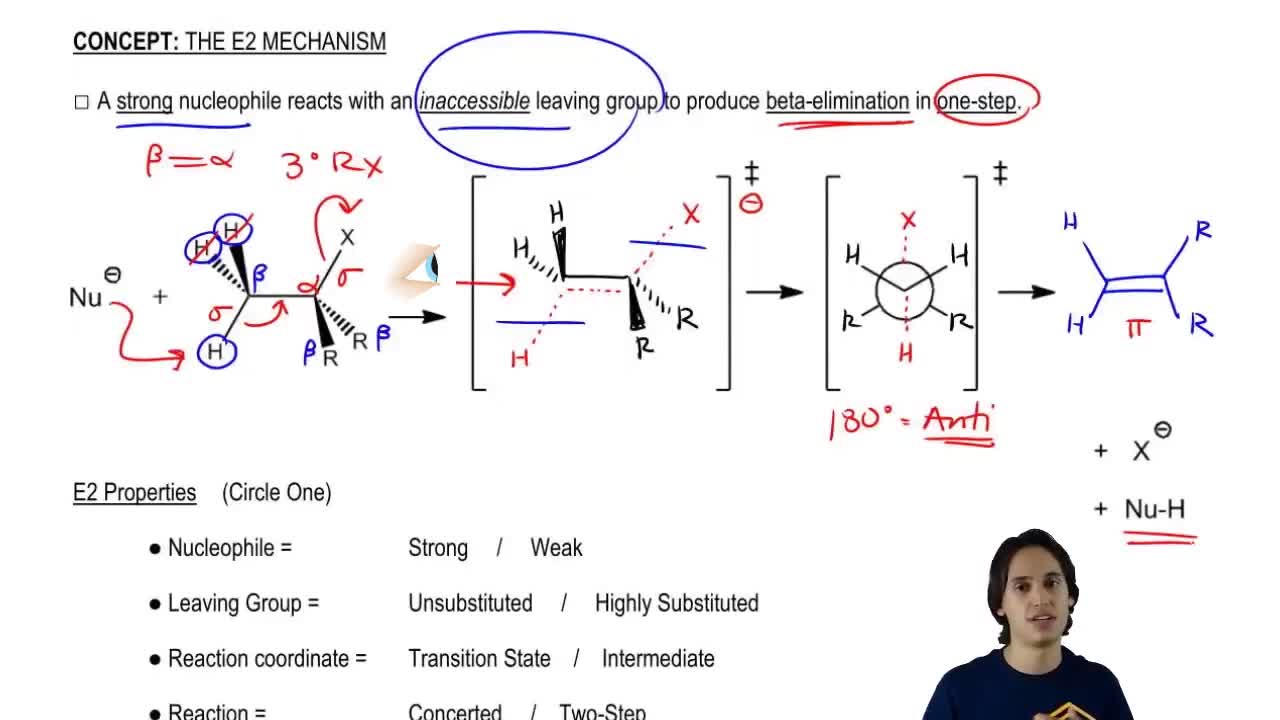
    The product of an E2 elimination reaction is an alkene, formed by the removal of a beta hydrogen and the leaving group from the substrate, resulting in a double bond between the alpha and beta carbons.
  • Which type of reagent will favor an E2 reaction with all substrates?
    A strong base (strong nucleophile) will favor an E2 reaction with all substrates, especially when the leaving group is inaccessible for SN2 substitution.
  • How is the major E2 product determined when an alkyl halide undergoes elimination?
    The major E2 product is the alkene formed by removal of the beta hydrogen that is antiperiplanar to the leaving group, resulting in the most substituted (more stable) alkene according to Zaitsev's rule, unless steric or stereochemical constraints favor a less substituted product.
  • What type of organic bromide would undergo E2 dehydrohalogenation to give 1-hexene as the sole alkene product?
    A bromide with the leaving group on the terminal carbon of hexane (1-bromohexane) would undergo E2 dehydrohalogenation to give 1-hexene as the pure alkene product.
  • Under E2 conditions, which beta hydrogen in a compound is most readily abstracted?
    The beta hydrogen that is antiperiplanar (180 degrees apart) to the leaving group is most readily abstracted under E2 conditions, as this alignment is required for the reaction to proceed.
  • Which type of alkyl halide reacts the fastest in an E2 reaction?
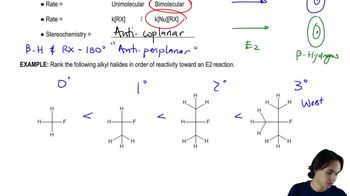
    A highly substituted (tertiary) alkyl halide reacts the fastest in an E2 reaction because steric hindrance prevents SN2 substitution and favors elimination.
  • What is the role of the nucleophile in the E2 mechanism when the leaving group is inaccessible?
    The nucleophile acts as a base and abstracts a beta hydrogen from the substrate. This initiates the elimination process, leading to the formation of a double bond.
  • Why must the beta hydrogen and leaving group be 180 degrees apart in an E2 reaction?
    They must be antiperiplanar to allow for proper orbital alignment during the concerted elimination process. This geometric requirement ensures the reaction can proceed efficiently.
  • How does the substitution level of the alkyl halide affect the competition between SN2 and E2 mechanisms?
    Highly substituted alkyl halides favor E2 over SN2 because steric hindrance blocks backside attack. Less substituted alkyl halides are more likely to undergo SN2 substitution.
  • What does the '2' in E2 indicate about the reaction rate law?
    The '2' signifies that the reaction is bimolecular, depending on both the nucleophile and the alkyl halide concentrations. Doubling either reactant's concentration will double the reaction rate.