Back

EAS:Nitration Mechanism definitions

Control buttons has been changed to "navigation" mode.
1/15
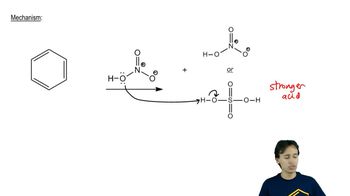
  • Nitronium Ion

    A highly reactive species with a full positive charge, generated from acids, serving as the key electrophile in aromatic nitration.
  • Electrophilic Aromatic Substitution

    A reaction where an aromatic ring replaces a hydrogen with an electrophile, preserving aromaticity after substitution.
  • Benzene

    An aromatic hydrocarbon ring that acts as a nucleophile, attacking strong electrophiles in substitution reactions.
  • Nitric Acid

    A reagent that, when protonated, forms a water leaving group and helps generate the active nitrating species.
  • Sulfuric Acid

    A strong acid commonly used as a proton donor to activate nitric acid for nitronium ion formation.
  • Sigma Complex

    A resonance-stabilized carbocation intermediate formed after the aromatic ring attacks the electrophile.
  • Resonance

    A stabilizing effect in intermediates where charge and bonding are delocalized across multiple structures.
  • Deprotonation

    A step where a proton is removed from the intermediate, restoring aromaticity and completing substitution.
  • Nitrobenzene

    The aromatic product formed after nitration, featuring a nitro group attached to the benzene ring.
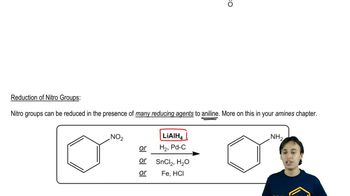
  • Aniline

    An aromatic amine produced by reducing a nitro group on benzene, serving as a key synthetic intermediate.
  • Reduction

    A transformation converting a nitro group to an amino group, often using strong or chemoselective reagents.
  • Lithium Aluminum Hydride

    A powerful reducing agent capable of converting nitro groups to amines efficiently in organic synthesis.
  • Catalytic Hydrogenation

    A process using hydrogen gas and a metal catalyst to reduce nitro groups to amines on aromatic rings.
  • Stannous Chloride

    A chemoselective reducing agent that specifically targets nitro groups for reduction without affecting other groups.
  • Chemoselectivity

    A property of certain reagents to selectively react with one functional group in the presence of others.