Back

EAS:Nitration Mechanism quiz

Control buttons has been changed to "navigation" mode.
1/15
  • What is the key electrophile involved in the nitration of benzene during EAS?

    The key electrophile is the nitronium ion (NO2+), which has a full positive charge and is highly reactive.
  • How is the nitronium ion (NO2+) typically generated in the nitration mechanism?

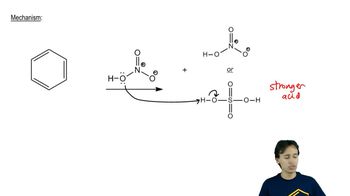
    It is generated by protonation and elimination from nitric acid, often using sulfuric acid as a proton donor.
  • Why is sulfuric acid used alongside nitric acid in nitration reactions?

    Sulfuric acid is a stronger acid and acts as the proton donor, facilitating the formation of the nitronium ion.
  • What role does heat play in the nitration of benzene?

    Heat helps drive the reaction forward, increasing the rate of nitronium ion formation and subsequent substitution.
  • Which atom in nitric acid acts as the base during nitronium ion generation?

    The oxygen atom with lone pairs acts as the base, accepting a proton and becoming a good leaving group.
  • What is the leaving group formed during the generation of the nitronium ion?

    Water (H2O) is formed as the leaving group when nitric acid is protonated and eliminated.
  • Describe the initial step when benzene reacts with the nitronium ion.

    Benzene attacks the nitronium ion, forming a sigma complex (arenium ion) stabilized by resonance.
  • What is the sigma complex in the nitration mechanism?

    The sigma complex is an intermediate where the benzene ring has temporarily lost aromaticity and holds a positive charge.
  • How is aromaticity restored in the benzene ring after nitration?

    A hydrogen is eliminated from the sigma complex, restoring aromaticity and yielding nitrobenzene.
  • What is the typical base used to remove the hydrogen from the sigma complex?

    Usually, the water formed earlier acts as the base to remove the hydrogen, but the conjugate base of the acid can also be used.
  • What is the final organic product of benzene nitration?

    The final product is nitrobenzene, which contains a nitro group attached to the benzene ring.
  • What functional group transformation is possible with nitrobenzene?

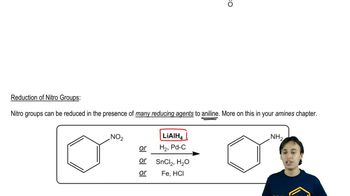
    Nitrobenzene can be reduced to aniline, converting the nitro group to an amino group.
  • Name a common reducing agent used to convert nitrobenzene to aniline.

    Lithium aluminum hydride (LiAlH4) is a strong and common reducing agent for this transformation.
  • Which reducing agent is chemoselective for nitro groups and why is it important?

    Stannous chloride (SnCl2) is chemoselective, meaning it specifically reduces nitro groups without affecting other functional groups.
  • What other reagents can reduce nitrobenzene to aniline besides LiAlH4 and SnCl2?

    Catalytic hydrogenation (H2 with Pd, Ni, or Pt), and iron or zinc with HCl are also commonly used reducing agents.