Back

Electron Counting definitions

Control buttons has been changed to "navigation" mode.
1/15
  • Octet Rule

    Guideline stating atoms are most stable with eight electrons in their valence shell, influencing reactivity and bonding.
  • Lewis Acid

    Species capable of accepting an electron pair to achieve a more stable electron configuration.
  • Sigma Bond

    Single covalent bond formed by direct overlap of atomic orbitals, contributing to electron sharing between atoms.
  • Pi Bond

    Bond formed by sideways overlap of p orbitals, often present in double or triple bonds, adding to electron count.
  • Lone Pair

    Non-bonding pair of electrons localized on an atom, affecting molecular shape and electron counting.
  • Transition Metal

    Element with partially filled d orbitals, capable of forming complexes with variable electron counts.
  • Valence Electrons

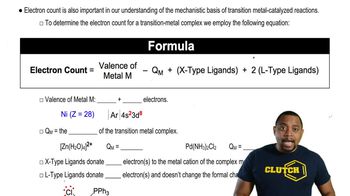
    Electrons in the outermost s and d orbitals of a transition metal, used for electron counting in complexes.
  • X Type Ligand

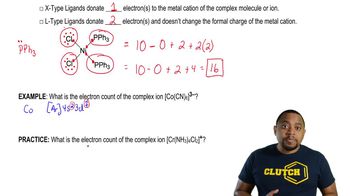
    Ligand donating one electron to a metal center, often a halide or similar group, impacting electron count.
  • L Type Ligand

    Ligand donating a lone pair (two electrons) to a metal, such as phosphines or amines, affecting complex stability.
  • Electron Configuration

    Arrangement of electrons in atomic orbitals, used to determine valence electrons for electron counting.
  • Noble Gas

    Element with a complete valence shell, serving as a reference for electron stability in other atoms.
  • Charge

    Net electrical value of a complex, subtracted in electron counting to account for electron loss or gain.
  • Complex

    Assembly of a central metal atom bonded to surrounding ligands, requiring electron counting for stability analysis.
  • Main Group Chemistry

    Branch focusing on s- and p-block elements, where the octet rule is a primary guideline for electron arrangements.
  • Condensed Electron Configuration

    Shorthand notation showing only the valence shell arrangement, simplifying electron counting for transition metals.