Organic Chemistry
My Course
Learn
Exam Prep
AI Tutor
Study Guides
Textbook Solutions
Flashcards
Explore
Try the app
My Course
Learn
Exam Prep
AI Tutor
Study Guides
Textbook Solutions
Flashcards
Explore
Try the app
Back
Electron Counting quiz
You can tap to flip the card.
What rule is used as an indicator of reactivity in main group chemistry?
You can tap to flip the card.
👆
What rule is used as an indicator of reactivity in main group chemistry?
The octet rule is used as an indicator of reactivity in main group chemistry.
Track progress
Control buttons has been changed to "navigation" mode.
1/15
Related flashcards
Related practice
Recommended videos
Electron Counting definitions
Electron Counting
15 Terms
27. Transition Metals
6 topics
14 problems
Chapter
Johnny
Guided course
01:53
Electron Counting Exercise 1
766
views
1
rank
Guided course
07:07
Electron Counting
914
views
2
rank
Terms in this set (15)
Hide definitions
What rule is used as an indicator of reactivity in main group chemistry?
The octet rule is used as an indicator of reactivity in main group chemistry.
How does an element with fewer than 8 electrons behave in terms of Lewis acid-base theory?
An element with fewer than 8 electrons acts as a Lewis acid by accepting electron pairs.
How does formaldehyde (CH2O) fulfill the octet rule for carbon?
Carbon in formaldehyde forms four bonds, giving it 8 electrons and fulfilling the octet rule.
What is the electron configuration used to determine the valence electrons for transition metals?
The valence electrons for transition metals are the sum of their s and d orbital electrons in the neutral atom.
What is the formula for calculating the electron count in a transition metal complex?
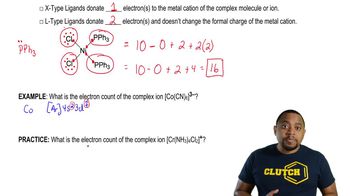
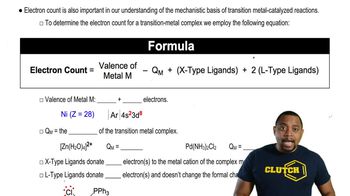
The formula is: valence of metal - charge + number of X type ligands + 2 × number of L type ligands.
What does 'qm' represent in the electron counting formula for transition metal complexes?
'qm' represents the overall charge of the transition metal complex.
How many electrons does an X type ligand donate to a transition metal?
An X type ligand donates 1 electron to the transition metal.
How many electrons does an L type ligand donate to a transition metal?
An L type ligand donates a lone pair, which is 2 electrons.
When calculating the valence electrons for a transition metal in a complex, do you use its charged or neutral form?
You use the neutral form of the transition metal to determine its valence electrons.
In the example given, what is the electron count for a nickel complex with 2 X type and 2 L type ligands?
The electron count is 16 for the nickel complex with 2 X type and 2 L type ligands.
Why is electron counting important for understanding transition metal reactivity?
Electron counting helps determine how many electrons a transition metal needs for stability, which is key to understanding its reactivity.
What is the role of the octet rule in main group compounds like nitrogen trichloride and water?
The octet rule ensures that the central atom in these compounds has 8 electrons through bonds and lone pairs.
What is the significance of d orbitals in transition metals regarding the octet rule?
D orbitals allow transition metals to expand beyond the octet rule.
What type of ligand is chlorine considered in electron counting, and how many electrons does it donate?
Chlorine is an X type ligand and donates 1 electron.
What is the first step in mastering the behavior of transition metals beyond the octet rule?
The first step is learning how to correctly count electrons in transition metal complexes.