Back

Electrophilic Aromatic Substitution definitions

Control buttons has been changed to "navigation" mode.
1/15
  • Aromaticity

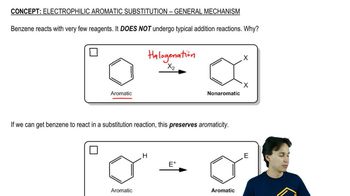
    A property granting extra stability to cyclic, planar molecules with delocalized pi electrons, making them resistant to typical addition reactions.
  • Benzene

    A six-membered aromatic ring with alternating double bonds, serving as the classic substrate for electrophilic aromatic substitution.
  • Electrophile

    A species with a positive charge or partial positive character that seeks electrons, initiating attack on electron-rich aromatic rings.
  • Sigma Complex

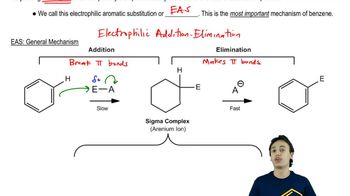
    A high-energy, resonance-stabilized carbocation intermediate formed after electrophile addition to an aromatic ring.
  • Arenium Ion

    A resonance-stabilized carbocation intermediate in aromatic substitution, also known as the sigma complex.
  • Resonance

    Delocalization of electrons across multiple atoms, stabilizing intermediates like the sigma complex during aromatic substitution.
  • Conjugate Base

    A species formed after an acid donates a proton, responsible for removing a hydrogen in the elimination step of EAS.
  • Beta Elimination

    A process where a hydrogen atom is removed from a carbon adjacent to a carbocation, restoring aromaticity in the final step.
  • Rate-Determining Step

    The slowest stage in a reaction mechanism, often involving formation of the high-energy sigma complex in EAS.
  • Substituted Arene

    An aromatic compound where a hydrogen atom has been replaced by another group via electrophilic aromatic substitution.
  • Halogenation

    A reaction involving the introduction of a halogen atom into an aromatic ring, requiring strong electrophiles to proceed.
  • Addition Reaction

    A process where pi bonds are broken and new sigma bonds are formed, generally avoided by aromatic rings to preserve stability.
  • Elimination Reaction

    A process that forms pi bonds, crucial in the final step of EAS to restore aromaticity after electrophile addition.
  • Acid

    A byproduct often formed during EAS, resulting from the removal of a proton in the elimination step.
  • Resonance Hybrid

    A depiction showing delocalized charge or electrons across several atoms, representing the true structure of intermediates like the sigma complex.