Back

Enolate Alkylation and Acylation definitions

Control buttons has been changed to "navigation" mode.
1/15
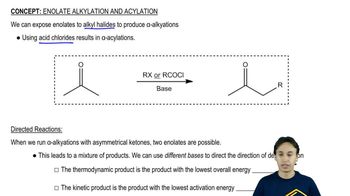
  • Enolate

    A resonance-stabilized intermediate formed by deprotonation at the alpha carbon of a carbonyl compound.
  • Alkyl Halide

    An organic molecule containing a halogen atom bonded to an sp3-hybridized carbon, used as an electrophile in alkylation.
  • Acid Chloride

    A reactive carboxylic acid derivative with a chlorine atom, commonly used for acylation reactions.
  • Alpha Carbon

    The carbon atom directly adjacent to a carbonyl group, often the site of deprotonation in enolate chemistry.
  • Beta Dicarbonyl

    A compound featuring two carbonyl groups separated by one carbon, often formed after acylation.
  • Symmetrical Ketone

    A ketone with identical groups on both sides of the carbonyl, allowing only one possible enolate.
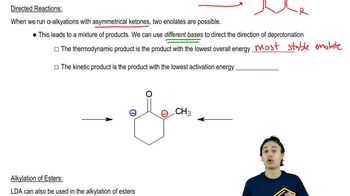
  • Asymmetrical Ketone

    A ketone with different groups on each side of the carbonyl, leading to multiple possible enolates.
  • Thermodynamic Product

    The more stable reaction outcome, typically with the most substituted alpha carbon and lowest overall energy.
  • Kinetic Product

    The reaction outcome formed fastest, usually with the least substituted alpha carbon due to lower steric hindrance.
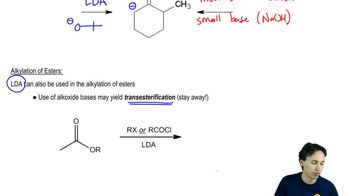
  • LDA

    A bulky, non-nucleophilic base (lithium diisopropylamide) that selectively forms enolates without side reactions.
  • Tert-Butoxide

    A bulky base that, like LDA, favors formation of the kinetic enolate by deprotonating less hindered positions.
  • NaOH

    A small, strong base that favors formation of the thermodynamic enolate by deprotonating more substituted positions.
  • Transesterification

    A process where an ester is converted into another ester through exchange of the alkoxy group, often unwanted in enolate chemistry.
  • Non-Nucleophilic Base

    A base that removes protons without participating in nucleophilic substitution or addition, preventing side reactions.
  • Resonance Structure

    Alternative Lewis structures for a molecule, showing delocalization of electrons, crucial for enolate stability.