Back

Enolate definitions

Control buttons has been changed to "navigation" mode.
1/15
  • Enolate

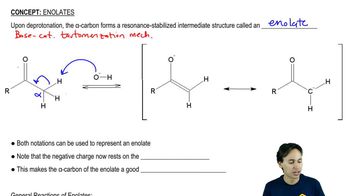
    A resonance-stabilized intermediate formed by deprotonating the alpha position of a carbonyl in base, with nucleophilic character at the alpha carbon.
  • Alpha Carbon

    The carbon atom directly adjacent to a carbonyl group, notable for its increased nucleophilicity in basic conditions.
  • Resonance Structure

    Alternative electron arrangements in a molecule, allowing negative charge delocalization between oxygen and carbon in enolates.
  • Base-Catalyzed Tautomerization

    A process where a base removes an alpha proton from a carbonyl, generating an enolate intermediate.
  • Nucleophile

    A species with electron density available to attack electrophilic centers, such as the alpha carbon in enolates.
  • Electrophile

    An electron-deficient species that can be attacked by nucleophiles, often reacting with enolates at the alpha position.
  • Carbonyl Group

    A functional group featuring a carbon double-bonded to oxygen, central to enolate and nucleophilic addition chemistry.
  • Tetrahedral Intermediate

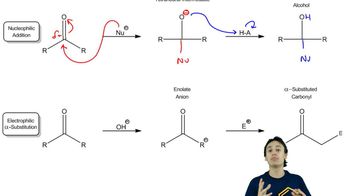
    A transient structure formed when a nucleophile adds to a carbonyl carbon, resulting in four substituents around the central atom.
  • Alpha Substitution

    A reaction where a hydrogen at the alpha position of a carbonyl is replaced by an electrophile via enolate chemistry.
  • Enolate Anion

    A negatively charged species with delocalized electrons, formed by deprotonation at the alpha carbon of a carbonyl.
  • Substituted Alcohol

    A product formed when a nucleophile adds to a carbonyl, followed by protonation, resulting in an alcohol with a new substituent.
  • Grignard Reaction

    A process where a Grignard reagent adds to a carbonyl, forming a tetrahedral intermediate and ultimately a substituted alcohol.
  • Reduction

    A reaction where a carbonyl compound gains electrons, often resulting in the formation of an alcohol.
  • Alpha Proton

    A hydrogen atom attached to the alpha carbon, which is removed by a base to generate an enolate.
  • Electrophilic Alpha Substitution

    A mechanism where an enolate intermediate enables the replacement of an alpha hydrogen with various electrophiles.