Back

Enolate quiz

Control buttons has been changed to "navigation" mode.
1/15
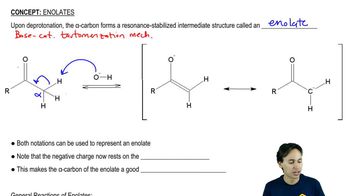
  • What intermediate is formed during base-catalyzed tautomerization of carbonyl compounds?

    An enolate intermediate is formed, which is resonance stabilized.
  • Where can the negative charge reside in an enolate's resonance structures?

    The negative charge can reside on either the oxygen or the alpha carbon.
  • Which resonance form of the enolate is most useful for predicting reaction products?

    The form with the negative charge on the alpha carbon is most useful for predicting products.
  • How does the reactivity of the alpha carbon in enolates differ from typical carbonyl chemistry?

    In enolates, the alpha carbon acts as a nucleophile, whereas in typical carbonyl chemistry, the carbonyl carbon is an electrophile.
  • What is the main role of the alpha carbon in enolate chemistry?

    The alpha carbon serves as a good nucleophile in basic solutions.
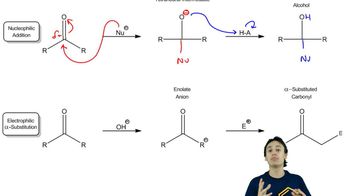
  • What happens when a base removes an alpha proton from a carbonyl compound?

    An enolate anion is formed, which can attack electrophiles.
  • What type of products are formed when enolates react with electrophiles?

    Alpha-substituted carbonyl compounds are formed.
  • What is the general theme of enolate-mediated reactions?

    Hydrogens at the alpha position are substituted with various electrophiles.
  • What is the mechanism called when enolates substitute hydrogen at the alpha position with electrophiles?

    This mechanism is called Electrophilic Alpha Substitution.
  • How does nucleophilic addition to carbonyls typically proceed?

    A nucleophile attacks the partially positive carbonyl carbon, forming a tetrahedral intermediate and then a substituted alcohol.
  • What happens to the O negative in the tetrahedral intermediate during nucleophilic addition?

    It protonates because there are no good leaving groups, resulting in a substituted alcohol.
  • What is the difference between nucleophilic addition and enolate chemistry?

    Nucleophilic addition adds to the carbonyl carbon, while enolate chemistry substitutes at the alpha carbon.
  • What is the significance of enolate formation in organic chemistry?

    Enolate formation opens up a new branch of carbonyl chemistry, allowing for alpha substitution reactions.
  • What is required to generate an enolate from a carbonyl compound?

    A base is required to deprotonate the alpha position and generate the enolate.
  • What is the outcome when enolates attack random electrophiles?

    The alpha carbon becomes substituted, resulting in alpha-substituted carbonyl products.