Skip to main content
Organic Chemistry
My Course
Learn
Exam Prep
AI Tutor
Study Guides
Textbook Solutions
Flashcards
Explore
Try the app
My Course
Learn
Exam Prep
AI Tutor
Study Guides
Textbook Solutions
Flashcards
Explore
Try the app
Back
Entropy definitions
You can tap to flip the card.
Entropy
You can tap to flip the card.
👆
Entropy
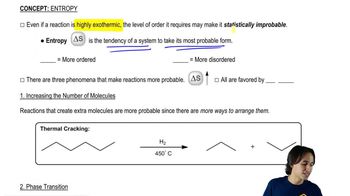
Tendency of a system to adopt its most probable, disordered state, reflecting the statistical likelihood of molecular arrangements.
Track progress
Control buttons has been changed to "navigation" mode.
1/15
Related flashcards
Related practice
Recommended videos
Entropy quiz
Entropy
15 Terms
Entropy
6. Thermodynamics and Kinetics
6 problems
Topic
Johnny
Hammond Postulate
6. Thermodynamics and Kinetics
6 problems
Topic
Nicole
6. Thermodynamics and Kinetics - Part 1 of 2
4 topics
11 problems
Chapter
Ernest
6. Thermodynamics and Kinetics - Part 2 of 2
4 topics
10 problems
Chapter
Johnny
07:11
3 ways to increase entropy.
2871
views
29
rank
6
comments
02:46
Explaining what entropy is.
3215
views
18
rank
Terms in this set (15)
Hide definitions
Entropy
Tendency of a system to adopt its most probable, disordered state, reflecting the statistical likelihood of molecular arrangements.
Disorder
State where molecules are arranged in numerous possible ways, making it statistically more probable than ordered arrangements.
Probability
Likelihood that a system will exist in a particular state, with higher values favoring more disordered molecular arrangements.
Delta S
Quantitative measure indicating the change in disorder; positive values mean increased disorder, negative values mean increased order.
Gibbs Free Energy
Thermodynamic quantity combining enthalpy, temperature, and entropy to predict reaction spontaneity using the equation ΔG = ΔH - TΔS.
Thermal Cracking
Process in the petroleum industry where large hydrocarbons are split into smaller molecules at high temperatures, increasing disorder.
Phase Transition
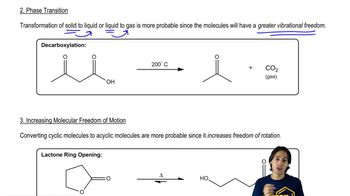
Change between solid, liquid, and gas states, where increased molecular motion and vibrational freedom raise disorder.
Vibrational Freedom
Extent to which molecules can move and vibrate, with higher values in liquids and gases compared to solids, enhancing disorder.
Acyclic Molecule
Structure with open carbon chains, allowing greater rotational freedom and more possible conformations than rings.
Cyclic Molecule
Structure with atoms connected in a ring, restricting rotational freedom and limiting possible conformations.
Lactone
Cyclic ester that, when opened, increases molecular freedom and disorder due to the formation of acyclic chains.
Conformer
Different spatial arrangement of a molecule due to rotation around single bonds, with more possible in flexible chains.
Decarboxylation
Reaction where a carboxylic acid loses CO2, often producing a gas and increasing the number of molecules and disorder.
Spontaneity
Tendency of a reaction to proceed without external input, favored by increased disorder and higher temperature.
Enthalpy
Thermodynamic property related to heat changes in reactions, distinct from disorder but part of the Gibbs equation.
 BackBack


 07:11
07:11