Back

Fischer Esterification quiz

Control buttons has been changed to "navigation" mode.
1/15
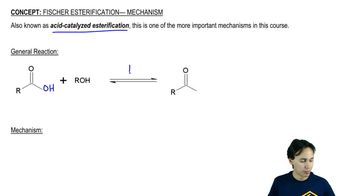
  • What are the starting materials and the main product in Fischer esterification?

    The starting materials are a carboxylic acid and an alcohol, and the main product is an ester.
  • What type of catalysis is involved in Fischer esterification?

    Fischer esterification is acid-catalyzed.
  • What is the first mechanistic step in Fischer esterification?

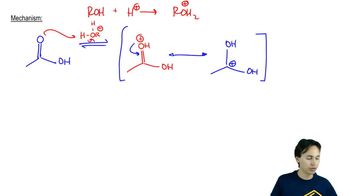
    The first step is protonation of the carboxylic acid.
  • What is the role of the acid in Fischer esterification?

    The acid acts as a catalyst, facilitating protonation and other steps but is regenerated at the end.
  • What is the nucleophile in the Fischer esterification mechanism?

    The nucleophile is the alcohol.
  • What key type of reaction is Fischer esterification an example of?

    It is an example of nucleophilic acyl substitution.
  • What happens after the nucleophilic attack in Fischer esterification?

    A proton transfer occurs to prepare for the elimination of water.
  • What group is eliminated during Fischer esterification?

    A water molecule (H2O) is eliminated.
  • What is the final mechanistic step in Fischer esterification?

    The final step is deprotonation to regenerate the acid catalyst.
  • Is Fischer esterification a reversible reaction?

    Yes, Fischer esterification is completely reversible.
  • How is the acid catalyst regenerated in Fischer esterification?

    It is regenerated during the final deprotonation step.
  • What is the purpose of the proton transfer step in the mechanism?

    The proton transfer makes one of the OH groups a better leaving group as water.
  • What other reaction mechanisms are similar to Fischer esterification?

    Mechanisms for acetals and imines are similar, as they also involve acid-catalyzed carbonyl reactions.
  • Why do professors often test Fischer esterification?

    Because it is a fundamental example of nucleophilic acyl substitution and illustrates key mechanistic steps.
  • What is the significance of resonance structures in the Fischer esterification mechanism?

    Resonance structures help illustrate the distribution of charge and electron movement during the reaction.