How do you assign formal charges to each atom in the three resonance forms of nitrous oxide (N2O)?
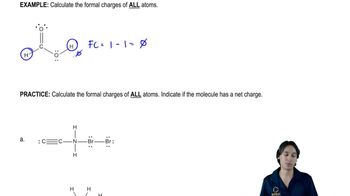
To assign formal charges in each resonance form of N2O, follow these steps for each atom: (1) Determine the group number (valence electrons) for each atom (nitrogen: 5, oxygen: 6). (2) Count the number of 'sticks' (bonds) and 'dots' (lone pair electrons) around each atom in the resonance structure. (3) Use the formula: Formal charge = group number β (number of sticks + number of dots). Repeat this for each atom in all three resonance forms. The sum of all formal charges in each resonance form should equal the net charge of the molecule (which is zero for neutral N2O).
What is the mathematical formula used to calculate the formal charge of an atom?
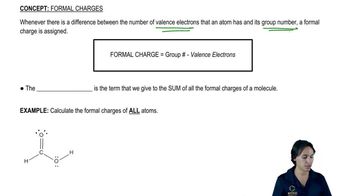
The formula is: Formal charge = group number β (number of sticks + number of dots). This calculation is performed for each atom individually.
How does the concept of bonding preferences relate to formal charges in molecules?
If an atom fulfills its bonding preference, its formal charge is typically zero. Bonding preferences help quickly identify atoms with zero formal charge without calculation.
What is the net charge of a molecule in terms of formal charges?
The net charge is the sum of all the formal charges on the individual atoms in the molecule. It represents the overall charge of the molecule.
Why is it important to check for missing lone pairs when calculating formal charges?
Missing lone pairs can lead to incorrect formal charge calculations. Ensuring all lone pairs are present gives an accurate count of valence electrons for each atom.
How do you determine the group number for an atom when calculating formal charge?
The group number corresponds to the number of valence electrons the atom ideally wants, based on its position in the periodic table. For example, oxygen is in group 6 and wants 6 valence electrons.
What does a formal charge of zero indicate about an atomβs bonding in a molecule?
A formal charge of zero means the atom is fulfilling its bonding preference and has the ideal number of valence electrons. This usually indicates a stable configuration.
Can you rely solely on bonding preferences to assign formal charges, and when should you calculate them mathematically?
Bonding preferences can quickly indicate a formal charge of zero, but mathematical calculation is safer for accuracy. Calculating is especially important when the structure is complex or unclear.
What is the significance of 'sticks' and 'dots' in the context of formal charge calculation?
'Sticks' represent bonds and 'dots' represent lone pair electrons around an atom. Together, they account for the actual valence electrons used in the formal charge formula.
How does fulfilling bonding preferences affect the need for formal charge calculation in simple molecules?
If all atoms fulfill their bonding preferences, formal charges are likely zero and calculation may be unnecessary. However, calculation ensures accuracy, especially in more complex molecules.