Skip to main content
Organic Chemistry
My Course
Learn
Exam Prep
AI Tutor
Study Guides
Textbook Solutions
Flashcards
Explore
Try the app
My Course
Learn
Exam Prep
AI Tutor
Study Guides
Textbook Solutions
Flashcards
Explore
Try the app
Back
Frost Circle definitions
You can tap to flip the card.
Frost Circle
You can tap to flip the card.
👆
Frost Circle
A diagrammatic tool using polygons to visualize molecular orbital energy levels in cyclic compounds.
Track progress
Control buttons has been changed to "navigation" mode.
1/15
Related flashcards
Related practice
Recommended videos
Frost Circle quiz
Inscribed Polygon Method
15 Terms
Frost Circle
18. Aromaticity
4 problems
Topic
Johnny
Naming Benzene Rings
18. Aromaticity
9 problems
Topic
Johnny
17. Aromaticity - Part 1 of 3
6 topics
13 problems
Chapter
Johnny
17. Aromaticity - Part 2 of 3
5 topics
12 problems
Chapter
Ernest
18. Aromaticity - Part 3 of 3
1 topic
3 problems
Chapter
02:56
Inscribed Polygon Method
1832
views
14
rank
8
comments
11:54
Inscribed Polygon Method
2332
views
16
rank
14
comments
Terms in this set (15)
Hide definitions
Frost Circle
A diagrammatic tool using polygons to visualize molecular orbital energy levels in cyclic compounds.
Hückel's Rule
A guideline stating that aromatic stability arises when a molecule has 2, 6, 10, 14, etc., pi electrons.
Molecular Orbital
A region in a molecule where electrons are likely to be found, depicted at each polygon vertex in the method.
Bonding Orbital
An energy level below the nonbonding line in the Frost circle, filled first and contributing to molecular stability.
Antibonding Orbital
An energy level above the nonbonding line, filled only after all bonding orbitals are occupied, leading to instability.
Nonbonding Line
The horizontal divider in the Frost circle separating bonding from antibonding molecular orbitals.
Pi Electron
An electron occupying a molecular orbital formed from sideways overlap of p orbitals in a ring system.
Degenerate Orbitals
Orbitals of equal energy, requiring even electron distribution according to Hund's rule.
Aromaticity
A property of cyclic molecules with completely filled bonding orbitals, resulting in exceptional stability.
Antiaromaticity
A property of cyclic molecules with partially filled bonding orbitals, causing unique instability.
Aufbau Principle
A rule dictating that electrons fill the lowest available energy orbitals before higher ones in the Frost circle.
Hund's Rule
A rule requiring electrons to occupy degenerate orbitals singly before pairing up.
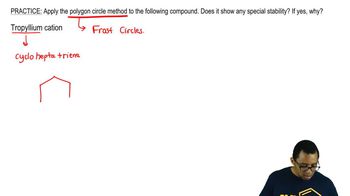
Inscribed Polygon Method
A technique for drawing polygons with one vertex down to represent molecular orbital energy levels.
Cyclobutadiene
A four-membered ring molecule used as an example of antiaromatic instability due to non-Hückel pi electron count.
Cyclopropenyl Anion
A three-membered ring with a negative charge, illustrating antiaromaticity in the Frost circle method.
 BackBack

 02:56
02:56