Back

Fukuyama Coupling Reaction definitions

Control buttons has been changed to "navigation" mode.
1/15
  • Fukuyama Coupling Reaction

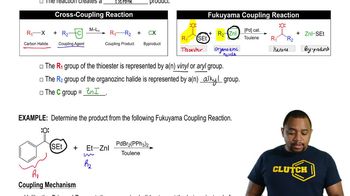
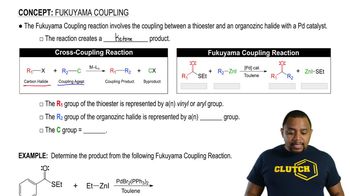
    A process joining a thioester and organozinc halide with palladium to selectively yield a ketone, avoiding further reduction.
  • Thioester

    A carboxylic acid derivative where the oxygen in an ester is replaced by sulfur, serving as a key reactant.
  • Organozinc Halide

    A compound containing a zinc atom bonded to an organic group and a halide, acting as a coupling partner.
  • Palladium Catalyst

    A transition metal species that enables bond formation and is regenerated during the reaction cycle.
  • Ketone

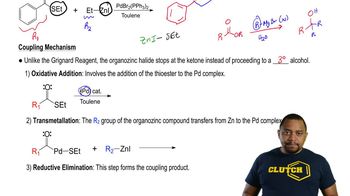
    A carbonyl-containing product formed by connecting acyl and alkyl groups, without further addition.
  • Oxidative Addition

    The initial step where the thioester attaches to palladium, forming a complex with the acyl group.
  • Transmetalation

    A stage where the organic group from zinc transfers to palladium, displacing the thioester fragment.
  • Reductive Elimination

    The final step forming the ketone by joining acyl and alkyl groups and regenerating the catalyst.
  • Toluene

    An aromatic solvent commonly used to facilitate the reaction environment.
  • Acyl Group

    A functional group derived from a carboxylic acid, central to forming the ketone product.
  • Vinyl Group

    An unsaturated hydrocarbon fragment often present as the R1 group in the reaction.
  • Aryl Group

    An aromatic ring system that can serve as the R1 group in the coupling process.
  • Alkyl Group

    A saturated hydrocarbon chain typically introduced as the R2 group from the organozinc halide.
  • Electron Rule

    A guideline (16 or 18 electrons) influencing the stability and reactivity of the palladium catalyst.
  • Byproduct

    A secondary substance, such as zinc iodide with a thioester fragment, formed alongside the main product.