Skip to main content
Organic Chemistry
My Course
Learn
Exam Prep
AI Tutor
Study Guides
Textbook Solutions
Flashcards
Explore
Try the app
My Course
Learn
Exam Prep
AI Tutor
Study Guides
Textbook Solutions
Flashcards
Explore
Try the app
Back
Gabriel Synthesis definitions
You can tap to flip the card.
Gabriel Synthesis
You can tap to flip the card.
👆
Gabriel Synthesis
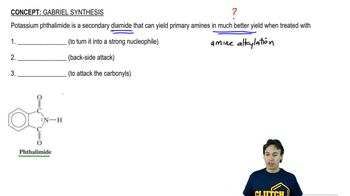
A method using potassium thalidomide to efficiently produce primary amines, avoiding polyalkylation and unwanted by-products.
Track progress
Control buttons has been changed to "navigation" mode.
1/15
Related flashcards
Related practice
Recommended videos
Gabriel Synthesis quiz
Gabriel Synthesis
15 Terms
Gabriel Synthesis
26. Amines
3 problems
Topic
Johnny
Amines by Reduction
26. Amines
7 problems
Topic
Johnny
23. Amines - Part 1 of 3
4 topics
11 problems
Chapter
Nicole
23. Amines - Part 2 of 3
5 topics
13 problems
Chapter
Nicole
26. Amines - Part 3 of 3
1 topic
3 problems
Chapter
05:42
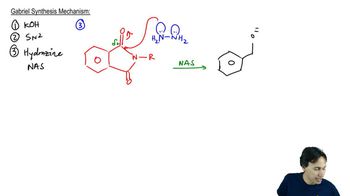
Mechanism
1816
views
21
rank
4
comments
04:53
General Reaction
1907
views
19
rank
8
comments
Terms in this set (15)
Hide definitions
Gabriel Synthesis
A method using potassium thalidomide to efficiently produce primary amines, avoiding polyalkylation and unwanted by-products.
Potassium Thalidomide
A secondary diamide anion formed by deprotonation, acting as a strong nucleophile in the synthesis of primary amines.
Primary Amine
A compound with a nitrogen atom bonded to one alkyl group and two hydrogens, the main product of this synthesis.
KOH
A strong base used to deprotonate thalidomide, generating the nucleophilic species needed for the reaction.
Alkyl Halide
A molecule containing a halogen attached to a primary carbon, serving as the electrophile in the SN2 step.
Hydrazine
A nucleophilic reagent (NH2NH2) that cleaves the nitrogen from thalidomide, enabling release of the primary amine.
SN2 Mechanism
A one-step nucleophilic substitution involving backside attack, leading to inversion of configuration at the electrophilic carbon.
Nucleophile
A species with a lone pair or negative charge, capable of attacking electrophilic centers in organic reactions.
Nucleophilic Acyl Substitution
A mechanism where a nucleophile replaces a leaving group on a carbonyl compound, forming a tetrahedral intermediate.
Tetrahedral Intermediate
A transient structure formed during nucleophilic attack on a carbonyl, featuring four groups attached to the central carbon.
Proton Transfer
A step where a hydrogen ion moves between atoms, often stabilizing intermediates or facilitating leaving group departure.
Polyalkylation
An undesired process where multiple alkyl groups attach to a nitrogen, leading to mixtures rather than a single primary amine.
Leaving Group
An atom or group that departs with a pair of electrons during a substitution or elimination reaction.
Carboxylic Acid Derivative
A compound structurally related to carboxylic acids, such as amides, which can undergo nucleophilic substitution.
Diamide
A molecule containing two amide groups, as seen in thalidomide, which influences its reactivity in synthesis.
 BackBack

 05:42
05:42