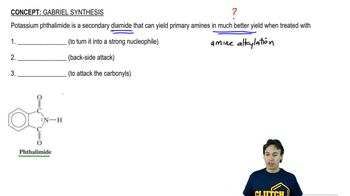
What is the main purpose of the Gabriel synthesis in organic chemistry?
The Gabriel synthesis is used to efficiently produce primary amines, avoiding issues like polyalkylation and unwanted by-products.
Which molecule is central to the Gabriel synthesis method?
Potassium thalidomide is the key molecule used in the Gabriel synthesis.
What are the three main reagents required for the Gabriel synthesis?
The three main reagents are KOH, a primary alkyl halide (RX), and hydrazine (N2H4).
What role does KOH play in the Gabriel synthesis?
KOH deprotonates the nitrogen in thalidomide, forming potassium thalidomide, a strong nucleophile.
Why is potassium thalidomide considered a strong nucleophile?
Potassium thalidomide has a negatively charged nitrogen, making it a strong base and nucleophile.
What type of reaction occurs between potassium thalidomide and the alkyl halide?
An SN2 backside attack occurs, where potassium thalidomide attacks the alkyl halide.
Why is a primary alkyl halide used in the Gabriel synthesis?
A primary alkyl halide is used to ensure efficient SN2 reaction and avoid side reactions.
What is the product after the SN2 reaction in Gabriel synthesis?
The product is a nitrogen atom attached to the alkyl group (R), still linked to thalidomide.
What reagent is used to cleave the nitrogen from thalidomide in the final step?
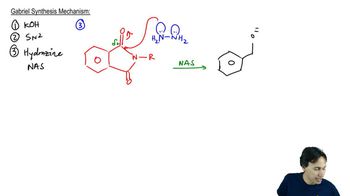
Hydrazine (N2H4) is used to cleave the nitrogen from thalidomide.
What mechanism does hydrazine follow to release the primary amine?
Hydrazine follows a nucleophilic substitution (NAS) mechanism, forming a tetrahedral intermediate.
What happens during the NAS mechanism in the Gabriel synthesis?
A proton transfer occurs, and the nitrogen with the R group is expelled, yielding the primary amine.
What is the final product of the Gabriel synthesis?
The final product is a primary amine (NRH), where R is the desired alkyl group.
How does Gabriel synthesis avoid polyalkylation?
Gabriel synthesis uses a controlled mechanism that releases only the desired primary amine, preventing multiple alkylations.
Why is Gabriel synthesis preferred over amine alkylation for making primary amines?
Gabriel synthesis is more efficient and avoids unwanted by-products compared to amine alkylation.
What is the significance of the proton transfer step in the NAS mechanism?
The proton transfer helps to neutralize charges and facilitates the expulsion of the nitrogen with the R group, completing the formation of the primary amine.
 Back
Back

 05:42
05:42