Back

Glycoside quiz

Control buttons has been changed to "navigation" mode.
1/15
  • What is the key reaction of monosaccharides in acidic conditions called?

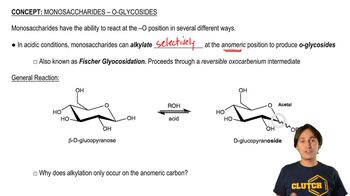
    The key reaction is called O-glycosidation, which selectively occurs at the anomeric position to form O-glycosides.
  • At which position does O-glycosidation occur in monosaccharides?

    O-glycosidation occurs selectively at the anomeric position of monosaccharides.
  • What type of functional group is formed at the anomeric carbon during O-glycosidation?

    An acetal functional group is formed at the anomeric carbon, specifically called an O-glycoside.
  • What are the typical reactants used in the O-glycosidation of beta-D-glucopyranose?

    The typical reactants are beta-D-glucopyranose, an alcohol (ROH), and acid.
  • What is the first mechanistic step in O-glycosidation?

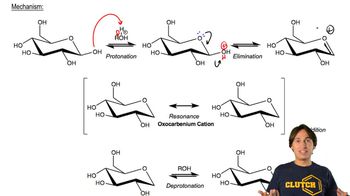
    The first step is protonation of the anomeric alcohol to create a good leaving group.
  • What intermediate is formed after elimination of water in the O-glycosidation mechanism?

    An oxocarbenium cation intermediate is formed after water is eliminated.
  • Why does O-glycosidation only occur at the anomeric position?

    It only occurs at the anomeric position because only this position can form a resonance-stabilized oxocarbenium cation intermediate.
  • What is the role of the alcohol (ROH) in the O-glycosidation reaction?

    The alcohol acts as a nucleophile, attacking the oxocarbenium cation to form the glycosidic bond.
  • What mixture of products is typically obtained from O-glycosidation?

    A mixture of alpha and beta anomers is obtained due to mutarotation and equilibrium.
  • What is the similarity between O-glycosidation and Fischer esterification?

    Both are acid-catalyzed reactions that proceed through a reversible intermediate and involve oxygen-containing compounds.
  • What is the significance of the resonance structures of the oxocarbenium cation?

    The resonance structures stabilize the cation, making the reaction possible only at the anomeric position.
  • What is the final step in the O-glycosidation mechanism?

    The final step is deprotonation by the conjugate base to yield the O-glycoside product.
  • What is the general outcome of O-glycosidation in terms of functional groups?

    The outcome is the formation of an acetal (O-glycoside) at the anomeric carbon.
  • Why can't O-glycosidation occur at positions other than the anomeric carbon?

    Other positions lack the adjacent oxygen needed to form the resonance-stabilized oxocarbenium cation.
  • What is the structural feature that distinguishes an O-glycoside from other acetals?

    An O-glycoside has an R group attached specifically to the oxygen at the anomeric position of a monosaccharide.