Grignard Reaction quiz #1 Flashcards

Grignard Reaction quiz #1
Control buttons has been changed to "navigation" mode.
1/10
  • What is the key bond formed during a Grignard reaction?
    The key bond formed in a Grignard reaction is a carbon–carbon (C–C) bond, created when the nucleophilic carbon of the Grignard reagent attacks an electrophilic carbon, such as the carbonyl carbon in aldehydes, ketones, or esters.
  • The Grignard reaction is based on the chemistry of what type of species?
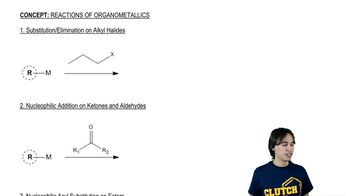
    The Grignard reaction is based on the chemistry of organometallic species, which act as strong nucleophiles and react with electrophilic carbons in various substrates.
  • How do you determine whether a carbon in an alkyl halide is an electrophile or a nucleophile?
    You look at the atom with the higher bonding preference, which is carbon, and if it has a positive charge, it is an electrophile. The halogen's charge is ignored for this determination.
  • What happens to the metal (M) in an organometallic reagent during a substitution reaction with an alkyl halide?
    The metal (M) leaves as a cation and often forms an ionic bond with the leaving group (X). It does not remain attached to the organic product.
  • What is the key intermediate formed during nucleophilic addition of an organometallic to a carbonyl compound?
    A tetrahedral intermediate is formed, featuring an O- and the newly added R group. This intermediate is then protonated to yield the final alcohol product.
  • How can you determine the degree (primary, secondary, tertiary) of the alcohol formed in a Grignard addition to a carbonyl?
    Count the number of alkyl groups attached to the carbon bearing the OH group after the reaction. The total determines if the alcohol is primary, secondary, or tertiary.
  • Why do esters require two equivalents of an organometallic reagent in their reaction mechanism?
    The first equivalent forms a ketone intermediate by nucleophilic acyl substitution, and the second equivalent reacts with the ketone to form a tertiary alcohol. This results in two identical R groups being added to the final product.
  • What is a distinguishing feature of the product when an ester reacts with excess organometallic reagent?
    The final alcohol product contains two identical R groups from the organometallic reagent. This indicates that the reaction occurred twice: first with the ester, then with the resulting ketone.
  • In a base-catalyzed epoxide ring opening with an organometallic, which carbon does the nucleophile attack?
    The nucleophile attacks the less substituted carbon of the epoxide ring. This is characteristic of base-catalyzed (not acid-catalyzed) ring openings.
  • What stereochemical outcome is expected from a nucleophilic ring opening of an epoxide by an organometallic reagent?
    The nucleophile and the oxygen end up anti to each other, resulting in anti addition. This often creates a chiral center and leads to a pair of enantiomers.