Back

H NMR Table definitions

Control buttons has been changed to "navigation" mode.
1/15
  • Chemical Shift

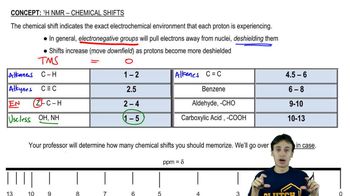
    Numerical value in ppm indicating how shielded or deshielded a proton is relative to a reference compound in NMR.
  • Deshielding

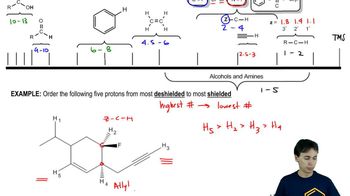
    Effect where electron withdrawal by nearby groups exposes a proton, causing its NMR signal to appear at a higher ppm.
  • Shielding

    Condition where electron density around a proton protects it, resulting in a lower ppm value in NMR.
  • TMS

    Reference compound in proton NMR, assigned a chemical shift of 0 ppm for calibration.
  • Alkane

    Hydrocarbon group with protons showing the lowest chemical shifts, typically around 1-2 ppm due to high shielding.
  • Alkyne

    Hydrocarbon with a triple bond, with proton signals appearing at 2.5-3 ppm in NMR.
  • ZCH Group

    Proton attached to a carbon next to an electronegative atom or group, causing shifts between 2-4 ppm.
  • Alkene

    Hydrocarbon with a double bond, with proton signals in the 4.5-6 ppm range due to moderate deshielding.
  • Benzene Ring

    Aromatic system where protons resonate at 6-8 ppm, reflecting significant deshielding from ring currents.
  • Aldehyde

    Functional group with a proton adjacent to a carbonyl, producing a signal at 9-10 ppm due to strong deshielding.
  • Carboxylic Acid

    Functional group with the most deshielded proton, resonating at 10-13 ppm in NMR.
  • Electronegative Group

    Atom or group that withdraws electron density, increasing the chemical shift of nearby protons.
  • Substitution

    Degree to which an alkane carbon is bonded to other carbons, affecting its proton's chemical shift.
  • Alkyl Halide

    Compound where a halogen is bonded to an alkane carbon, causing proton shifts that vary with halogen electronegativity.
  • Alcohol

    Functional group with a broad NMR shift range (1-5 ppm), making its proton signals less diagnostic.