Back

H NMR Table quiz

Control buttons has been changed to "navigation" mode.
1/15
  • What does the chemical shift in proton NMR indicate about a proton's environment?

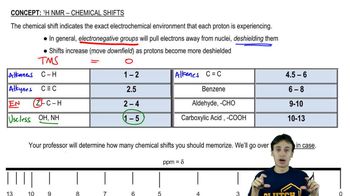
    It indicates how deshielded a proton is, with higher shifts meaning more deshielding due to electronegative groups pulling electrons away.
  • What is the reference compound for chemical shifts in H NMR, and what is its chemical shift value?

    Tetramethylsilane (TMS) is the reference, and its chemical shift is defined as 0 ppm.
  • What is the typical chemical shift range for protons in alkanes?

    Alkane protons typically appear in the 1-2 ppm range.
  • How does the substitution of an alkane affect its chemical shift?

    More substituted alkanes have higher chemical shifts; tertiary alkanes are around 1.8 ppm, secondary around 1.4 ppm, and primary around 1.1 ppm.
  • What is the chemical shift range for protons on alkynes (triple bonds)?

    Alkyne protons typically appear between 2.5 and 3 ppm.
  • How do electronegative groups (Z) next to a proton affect its chemical shift?

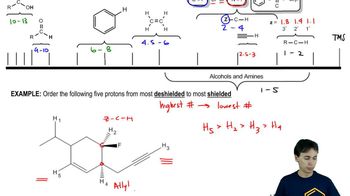
    Electronegative groups increase the chemical shift, with the exact value depending on the group's electronegativity.
  • What chemical shift is typical for protons next to fluorine or oxygen?

    Protons next to fluorine or oxygen usually appear around 4 ppm.
  • What is the chemical shift range for alcohol and amine protons, and why is it considered less useful?

    Alcohol and amine protons appear between 1 and 5 ppm, but this range is so broad that it is not very useful for precise identification.
  • What is the chemical shift range for alkene (double bond) protons?

    Alkene protons typically appear between 4.5 and 6 ppm.
  • Where do benzene ring protons typically appear in the H NMR spectrum?

    Benzene ring protons appear in the 6-8 ppm range.
  • What is the chemical shift range for aldehyde protons?

    Aldehyde protons typically appear between 9 and 10 ppm.
  • What is the chemical shift range for carboxylic acid protons?

    Carboxylic acid protons appear between 10 and 13 ppm.
  • How do nitrogen and iodine as neighboring atoms affect the chemical shift of a proton?

    Protons next to nitrogen or iodine typically appear around 3 ppm, with iodine being the least shifted among the halides.
  • What is the general trend for chemical shifts as the electronegativity of neighboring groups increases?

    As the electronegativity of neighboring groups increases, the chemical shift increases (moves downfield).
  • Why are the chemical shifts for alcohols and amines considered 'useless' for structure determination?

    Because their shifts span a wide range (1-5 ppm), making it difficult to identify them precisely based on chemical shift alone.