Back

Halogenation definitions

Control buttons has been changed to "navigation" mode.
1/15
  • Halogenation

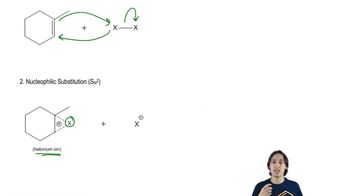
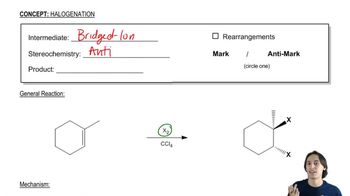
    Addition of a diatomic halogen to a double bond, yielding anti vicinal dihalides without carbocation intermediates.
  • Vicinal Dihalide

    A compound with two halogen atoms attached to adjacent carbons, resulting from anti addition across a double bond.
  • Halonium Ion

    A three-membered ring intermediate with a halogen atom bridging two carbons, distributing positive charge.
  • Anti Addition

    A process where substituents add to opposite sides of a double bond, leading to products with trans stereochemistry.
  • Backside Attack

    A nucleophilic approach from the side opposite the leaving group, characteristic of SN2 mechanisms in ring opening.
  • SN2 Mechanism

    A concerted substitution process where bond formation and bond breaking occur simultaneously, leading to inversion.
  • Enantiomer

    One of a pair of stereoisomers that are non-superimposable mirror images, formed in equal amounts in this reaction.
  • Racemic Mixture

    A 1:1 mixture of two enantiomers, resulting from equal formation of both stereoisomers during the reaction.
  • Carbocation

    A positively charged carbon species, notably absent in this mechanism, preventing rearrangements.
  • Polarizability

    The ease with which an electron cloud can be distorted, making halogens susceptible to nucleophilic attack.
  • Electrophile

    A species that accepts electrons, such as a partially positive halogen in the initial step of halogenation.
  • Solvent

    A medium like CCl4 or CH2Cl2, inert and polar, facilitating the reaction without participating chemically.
  • Chiral Center

    A carbon atom bonded to four different groups, leading to stereoisomer formation in the product.
  • Three-Membered Ring

    A strained cyclic intermediate formed during halogenation, later opened by nucleophilic attack.
  • Partial Positive Charge

    A region of electron deficiency within the halonium ion, influencing the site of nucleophilic attack.