Hemiacetal quiz #1 Flashcards

Hemiacetal quiz #1
Control buttons has been changed to "navigation" mode.
1/10
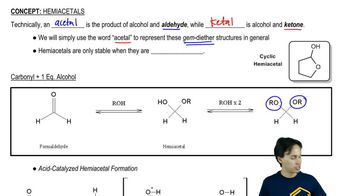
  • What is the structural definition of a hemiacetal, and how can you identify a hemiacetal functional group in a molecule?
    A hemiacetal is a functional group in which a single carbon atom is bonded to four groups: one hydroxyl group (OH), one alkoxy group (OR), and two other groups (which can be hydrogens or alkyl groups). The key identifying feature is the presence of both an OH and an OR group attached to the same carbon (the geminal position). Hemiacetals are typically only stable in cyclic forms; non-cyclic hemiacetals tend to convert to acetals or revert to the original carbonyl.
  • Describe the structure of the hemiacetal formed when ethanol reacts with propanal.
    When ethanol reacts with propanal, the hemiacetal formed has a central carbon (originally the carbonyl carbon of propanal) bonded to: (1) a hydroxyl group (OH), (2) an ethoxy group (OCH2CH3, from ethanol), (3) a propyl group (from propanal), and (4) a hydrogen. The structure can be represented as CH3CH(OH)(OCH2CH3)CH2H, where the central carbon is attached to both the OH and OCH2CH3 groups.
  • How can you classify a given structure as a hemiacetal based on its functional groups?
    To classify a structure as a hemiacetal, look for a carbon atom bonded to both a hydroxyl group (OH) and an alkoxy group (OR) in the geminal position. The other two groups attached to this carbon can be hydrogens or alkyl groups. If these features are present, the structure is a hemiacetal.
  • Why is the distinction between hemiacetal and hemiketal often ignored in organic chemistry discussions?
    The distinction is often ignored because aldehydes and ketones have similar reactivity and undergo identical nucleophilic addition reactions. As a result, the terms are used interchangeably in textbooks and lectures for simplicity.
  • What is the key structural feature of an acetal compared to a hemiacetal?
    An acetal has two alkoxy (OR) groups attached to the same carbon, while a hemiacetal has one hydroxyl (OH) and one alkoxy (OR) group on the same carbon. This makes acetals geminal diethers.
  • Why are non-cyclic hemiacetals generally unstable?
    Non-cyclic hemiacetals are unstable because they tend to either revert to the original carbonyl compound or react further with alcohol to form acetals. Only cyclic hemiacetals are typically stable enough to isolate.
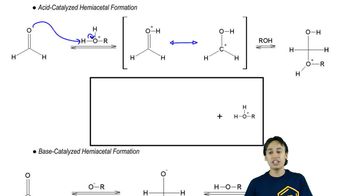
  • What is the first mechanistic step in the acid-catalyzed formation of a hemiacetal from a carbonyl compound?
    The first step is protonation of the carbonyl oxygen by an acid, increasing the electrophilicity of the carbonyl carbon. This makes it more susceptible to nucleophilic attack by alcohol.
  • In the acid-catalyzed mechanism, what is the purpose of drawing resonance structures after protonation of the carbonyl?
    Drawing resonance structures helps illustrate the increased electrophilicity of the carbonyl carbon after protonation. It clarifies the flow of electrons and the reactivity of the intermediate.
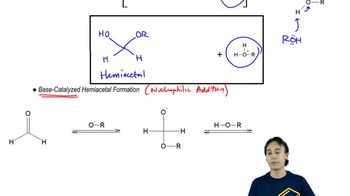
  • How does the base-catalyzed mechanism for hemiacetal formation differ from the acid-catalyzed mechanism?
    In the base-catalyzed mechanism, the alcohol is deprotonated to form an alkoxide ion, which is a strong nucleophile that directly attacks the carbonyl carbon. This process is generally simpler and does not require protonation steps.
  • What happens to a non-cyclic hemiacetal if it is exposed to excess alcohol under reaction conditions?
    A non-cyclic hemiacetal will typically react with another equivalent of alcohol to form an acetal. This conversion is favored under the reaction conditions, especially in the presence of acid or base catalysts.