Skip to main content
Organic Chemistry
My Course
Learn
Exam Prep
AI Tutor
Study Guides
Textbook Solutions
Flashcards
Explore
Try the app
My Course
Learn
Exam Prep
AI Tutor
Study Guides
Textbook Solutions
Flashcards
Explore
Try the app
Back
Hofmann Elimination definitions
You can tap to flip the card.
Hofmann Elimination
You can tap to flip the card.
👆
Hofmann Elimination
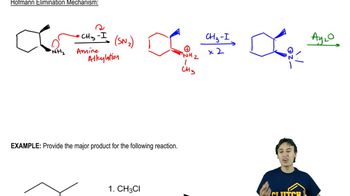
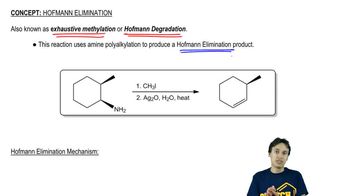
A reaction converting an amine into an alkene by making nitrogen a good leaving group, favoring the least substituted alkene.
Track progress
Control buttons has been changed to "navigation" mode.
1/15
Related flashcards
Related practice
Recommended videos
Hofmann Elimination quiz
Hofmann Elimination
15 Terms
Hofmann Elimination
26. Amines
2 problems
Topic
Johnny
Cope Elimination
26. Amines
4 problems
Topic
Laura
23. Amines - Part 1 of 3
4 topics
11 problems
Chapter
Nicole
23. Amines - Part 2 of 3
5 topics
13 problems
Chapter
Nicole
26. Amines - Part 3 of 3
1 topic
3 problems
Chapter
01:14
Provide the Major Product
1670
views
7
rank
3
comments
06:45
Mechanism
1879
views
12
rank
7
comments
03:22
General Reaction
1931
views
9
rank
2
comments
Terms in this set (15)
Hide definitions
Hofmann Elimination
A reaction converting an amine into an alkene by making nitrogen a good leaving group, favoring the least substituted alkene.
Exhaustive Methylation
A process where an amine undergoes repeated methylation until all hydrogens are replaced, forming a quaternary ammonium ion.
Quaternary Ammonium
A nitrogen atom bonded to four organic groups, carrying a positive charge, making it an excellent leaving group.
Alkyl Halide
A compound containing an alkyl group bonded to a halogen, commonly used to methylate amines in this reaction.
Silver Oxide
A reagent that, in the presence of iodide, generates hydroxide ions to promote elimination in the reaction.
Hydroxide Ion
A strong base produced in situ that abstracts a beta hydrogen, enabling the elimination to form an alkene.
Beta Elimination
A process where a base removes a hydrogen from the beta carbon, resulting in the formation of a double bond.
Hofmann Product
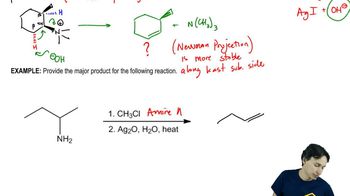
The least substituted alkene formed due to steric effects and antiperiplanar requirements in the elimination.
Zaitsev Product
The more substituted alkene, typically favored in other eliminations but not in this reaction.
Antiperiplanar Geometry
A spatial arrangement where the leaving group and the hydrogen being removed are on opposite sides, required for E2 elimination.
Newman Projection
A visual tool for analyzing conformations around single bonds, used to explain product selectivity in elimination.
Leaving Group
An atom or group that departs with an electron pair during a reaction, its quality determines reaction efficiency.
E2 Mechanism
A one-step elimination where a base removes a proton as the leaving group departs, requiring antiperiplanar alignment.
Steric Hindrance
A phenomenon where bulky groups impede reactions, influencing the formation of the least substituted alkene.
Gauss Interaction
A destabilizing interaction between groups in close proximity, influencing the preferred elimination pathway.
 BackBack


 01:14
01:14