Organic Chemistry
My Course
Learn
Exam Prep
AI Tutor
Study Guides
Textbook Solutions
Flashcards
Explore
Try the app
My Course
Learn
Exam Prep
AI Tutor
Study Guides
Textbook Solutions
Flashcards
Explore
Try the app
Back
HOMO LUMO definitions
You can tap to flip the card.
Frontier Molecular Orbital Theory
You can tap to flip the card.
👆
Frontier Molecular Orbital Theory
A framework explaining organic reactions by focusing on the interaction between the highest occupied and lowest unoccupied molecular orbitals.
Track progress
Control buttons has been changed to "navigation" mode.
1/13
Related flashcards
Related practice
Recommended videos
HOMO LUMO quiz
HOMO LUMO
15 Terms
HOMO LUMO
16. Conjugated Systems
3 problems
Topic

Johnny
16. Conjugated Systems - Part 1 of 3
4 topics
15 problems
Chapter
Johnny
16. Conjugated Systems - Part 2 of 3
6 topics
14 problems
Chapter
Johnny
16. Conjugated Systems - Part 3 of 3
6 topics
14 problems
Chapter
Johnny
Guided course
02:35
HOMO vs. LUMO
3118
views
16
rank
9
comments
Terms in this set (13)
Hide definitions
Frontier Molecular Orbital Theory
A framework explaining organic reactions by focusing on the interaction between the highest occupied and lowest unoccupied molecular orbitals.
HOMO
The molecular orbital with the highest energy that contains electrons, crucial for predicting electron donation in reactions.
LUMO
The molecular orbital with the lowest energy that is empty, serving as the primary site for electron acceptance.
Molecular Orbital
A region in a molecule where electrons are likely to be found, formed by combining atomic orbitals.
Atomic Orbital
A mathematical function describing the probability of finding an electron around a single atom.
Bonding Orbital
A molecular orbital formed by constructive overlap of atomic orbitals, resulting in electron density between nuclei.
Antibonding Orbital
A molecular orbital formed by destructive overlap of atomic orbitals, characterized by a node and higher energy.
Pi Orbital
A molecular orbital formed from side-by-side overlap of p orbitals, often involved in double bonds.
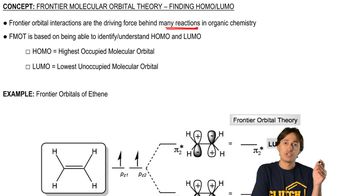
Pi 1 Orbital
The lower-energy bonding pi molecular orbital in ethene, fully occupied by electrons.
Pi 2* Orbital
The higher-energy antibonding pi molecular orbital in ethene, typically unoccupied.
Electron Configuration
The arrangement of electrons in molecular or atomic orbitals, determining chemical properties.
Energy Level
A quantized state that electrons can occupy within an atom or molecule, influencing reactivity.
Ethene
A simple molecule with a double bond, often used to illustrate concepts of molecular orbitals.