Skip to main content
Organic Chemistry
My Course
Learn
Exam Prep
AI Tutor
Study Guides
Textbook Solutions
Flashcards
Explore
Try the app
My Course
Learn
Exam Prep
AI Tutor
Study Guides
Textbook Solutions
Flashcards
Explore
Try the app
Back
Huckel's Rule definitions
You can tap to flip the card.
Aromaticity
You can tap to flip the card.
👆
Aromaticity
A property requiring a cyclic, fully conjugated, planar ring with a specific count of pi electrons, leading to unique stability.
Track progress
Control buttons has been changed to "navigation" mode.
1/14
Related flashcards
Related practice
Recommended videos
Huckel's Rule quiz
Four Tests of Aromaticity
15 Terms
Huckel's Rule
18. Aromaticity
4 problems
Topic
Ernest
Pi Electrons
18. Aromaticity
5 problems
Topic
Laura
17. Aromaticity - Part 1 of 3
6 topics
13 problems
Chapter
Johnny
17. Aromaticity - Part 2 of 3
5 topics
12 problems
Chapter
Ernest
18. Aromaticity - Part 3 of 3
1 topic
3 problems
Chapter
10:23
Four tests
3789
views
71
rank
14
comments
Terms in this set (14)
Hide definitions
Aromaticity
A property requiring a cyclic, fully conjugated, planar ring with a specific count of pi electrons, leading to unique stability.
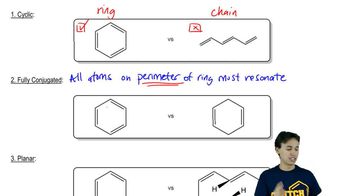
Cyclic Structure
A ring-shaped molecular framework essential for electron delocalization and resonance in aromatic compounds.
Conjugation
A continuous overlap of p orbitals around a ring, allowing for electron resonance and delocalization.
Planarity
A flat molecular arrangement enabling proper orbital alignment for resonance across a ring.
Pi Electrons
Electrons found in pi bonds or lone pairs that participate in resonance within a conjugated system.
Huckel's Rule
A guideline stating that aromatic rings must have 4n+2 pi electrons, where n is a non-negative integer.
Breslow's Rule
A criterion for anti-aromaticity, requiring 4n pi electrons in a cyclic, planar, fully conjugated ring.
Anti-aromatic Compound
A molecule meeting all aromaticity criteria except possessing 4n pi electrons, resulting in instability.
Non-aromatic Compound
A molecule failing one or more aromaticity tests, lacking the special stability of aromatic or anti-aromatic systems.
Resonance
The delocalization of electrons across adjacent atoms, stabilizing the ring structure in aromatic systems.
Isolated Diene
A structure with double bonds separated by non-conjugated atoms, preventing resonance and aromaticity.
Perimeter
The outermost atoms of a ring, all of which must participate in resonance for aromaticity.
Hybridization
The mixing of atomic orbitals, where sp3 centers disrupt conjugation and prevent aromaticity.
Benzene
A classic example of an aromatic molecule, featuring a six-membered planar ring with delocalized pi electrons.
 BackBack


 10:23
10:23