Back

Hydrates definitions

Control buttons has been changed to "navigation" mode.
1/13
  • Hydrate

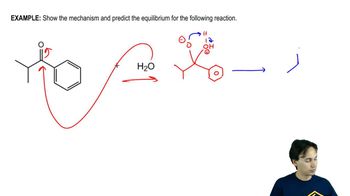
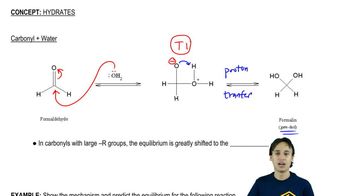
    A molecule where two hydroxyl groups are bonded to the same carbon, typically formed by water addition to a carbonyl.
  • Geminal Diol

    A compound featuring two hydroxyl groups attached to a single carbon atom, often resulting from hydrate formation.
  • Carbonyl Group

    A functional group consisting of a carbon atom double-bonded to an oxygen, serving as an electrophilic center in reactions.
  • Tetrahedral Intermediate

    A transient structure formed when a nucleophile attacks a carbonyl carbon, resulting in four substituents around the central atom.
  • Proton Transfer

    A step in a reaction mechanism where a hydrogen ion shifts from one atom or molecule to another, often stabilizing intermediates.
  • Formalin

    A solution containing the hydrate of formaldehyde, responsible for the characteristic odor in preserved biological specimens.
  • Formaldehyde

    A simple aldehyde that readily reacts with water to form its hydrate, commonly encountered in preservation solutions.
  • Steric Hindrance

    A phenomenon where bulky groups around a reactive center impede the approach of reactants, affecting reaction outcomes.
  • Equilibrium

    A state in a chemical reaction where the forward and reverse processes occur at equal rates, determining product and reactant ratios.
  • Electrophilic Carbon

    A carbon atom within a molecule that is electron-deficient and susceptible to attack by nucleophiles, such as in carbonyls.
  • Nucleophile

    A species with a lone pair of electrons that seeks out electron-deficient centers, initiating reactions with electrophiles.
  • 2-Butanone

    A ketone that, when mixed with water, partially forms hydrates, altering the expected composition in solution.
  • R Group

    A generic placeholder for any alkyl or aryl substituent attached to a functional group, influencing reactivity and sterics.