Organic Chemistry
My Course
Learn
Exam Prep
AI Tutor
Study Guides
Textbook Solutions
Flashcards
Explore
Try the app
My Course
Learn
Exam Prep
AI Tutor
Study Guides
Textbook Solutions
Flashcards
Explore
Try the app
Back
Hydrates quiz
You can tap to flip the card.
What type of molecule is formed when water reacts with a carbonyl group?
You can tap to flip the card.
👆
What type of molecule is formed when water reacts with a carbonyl group?
A hydrate, specifically a geminal diol, is formed when water reacts with a carbonyl group.
Track progress
Control buttons has been changed to "navigation" mode.
1/15
Related flashcards
Related practice
Recommended videos
Hydrates definitions
Hydrates
13 Terms
19. Aldehydes and Ketones:Nucleophilic Addition - Part 1 of 3
5 topics
14 problems
Chapter
Johnny
19. Aldehydes and Ketones:Nucleophilic Addition - Part 2 of 3
1 topic
13 problems
Chapter
Johnny
19. Aldehydes and Ketones:Nucleophilic Addition - Part 3 of 3
2 topics
13 problems
Chapter
Ernest
Guided course
01:57
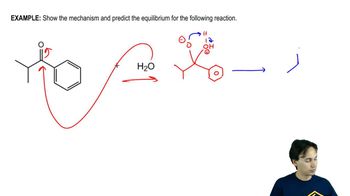
Show the mechanism, predict the equilibrium
1792
views
16
rank
6
comments
Guided course
04:10
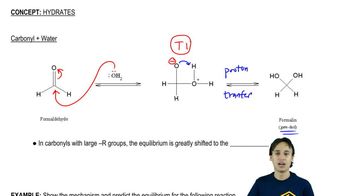
Mechanism
1946
views
13
rank
9
comments
Terms in this set (15)
Hide definitions
What type of molecule is formed when water reacts with a carbonyl group?
A hydrate, specifically a geminal diol, is formed when water reacts with a carbonyl group.
What is a geminal diol?
A geminal diol is a molecule where two hydroxyl groups are attached to the same carbon atom.
What initiates the reaction between water and a carbonyl group?
The lone pairs on the oxygen atom of water attack the electrophilic carbon of the carbonyl group.
What intermediate is formed during the reaction of water with a carbonyl?
A tetrahedral intermediate is formed during the reaction.
What happens after the tetrahedral intermediate is formed in hydrate formation?
A proton transfer occurs, where an oxygen atom grabs a hydrogen from another part of the intermediate.
Why is the oxygen from water positively charged in the intermediate?
It is positively charged because it has gained an extra bond after attacking the carbonyl carbon.
What is formalin and how is it formed?
Formalin is the hydrate formed from formaldehyde reacting with water.
What is responsible for the smell in preserved biological specimens?
Formalin, not formaldehyde, is responsible for the characteristic smell in preserved specimens.
Why is hydrate formation not synthetically useful for larger carbonyl compounds?
Steric hindrance from large R groups makes the tetrahedral intermediate less favorable, shifting equilibrium toward the carbonyl.
How does the size of R groups affect hydrate formation equilibrium?
Larger R groups shift the equilibrium toward the original carbonyl, while smaller R groups favor hydrate formation.
Which carbonyl compound is most likely to form a hydrate in equilibrium?
Formaldehyde, due to its small size and minimal steric hindrance, is most likely to form a hydrate.
What happens when you mix a 50% solution of 2-butanone with water in the lab?
Some of the mixture will form a hydrate, altering the expected composition.
What is the main step called when an oxygen atom grabs a hydrogen during hydrate formation?
This step is called a proton transfer.
Why do larger carbonyl compounds rarely form hydrates?
Because steric hindrance makes the tetrahedral intermediate less stable, favoring the carbonyl form.
What is the predominant product when formaldehyde reacts with water?
The predominant product is formalin, the hydrate form, due to minimal steric hindrance.