What is the first step in the hydroboration mechanism when adding boron to an alkene using a boron source such as BH3?
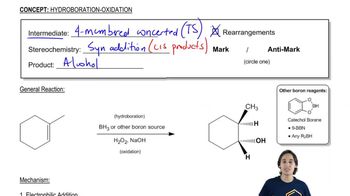
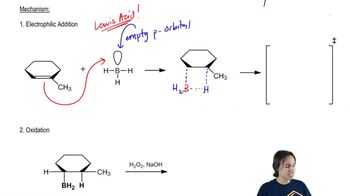
The first step in the hydroboration mechanism involves the alkene's double bond donating electrons to the empty p-orbital of boron (from BH3 or another boron source), forming a four-membered concerted transition state. In this step, boron attaches to the less substituted carbon of the double bond (due to steric hindrance), while a hydrogen from boron adds to the more substituted carbon. This syn addition occurs simultaneously, resulting in both boron and hydrogen being added to the same side of the former double bond.
What type of stereochemistry does hydroboration-oxidation produce in its final product?
Hydroboration-oxidation produces syn addition, resulting in cis products. This means the added groups are on the same side of the former double bond.
Why does hydroboration-oxidation not result in rearrangement of the carbon skeleton?
There is no carbocation intermediate in hydroboration-oxidation, so rearrangement does not occur. The reaction proceeds through a concerted transition state instead.
Which position on the alkene does boron preferentially add to during hydroboration, and why?
Boron adds to the least substituted carbon of the alkene. This is due to steric hindrance making the less substituted position easier to approach.
What is the role of hydrogen peroxide and base in the hydroboration-oxidation reaction?
Hydrogen peroxide and base are used in the oxidation step to convert the boron-bound intermediate into an alcohol. This step maintains the syn addition configuration.
How does the four-membered transition state in hydroboration-oxidation affect the product's stereochemistry?
The four-membered transition state ensures that both boron and hydrogen are added to the same side of the double bond. This leads to syn addition and cis products.
What are some alternative boron sources that can be used in hydroboration besides BH3 and B2H6?
Alternative boron sources include catecholborane, 9-BBN, and any molecule with the formula R2BH. The choice depends on the instructor or textbook.
How does hydroboration-oxidation differ from hydration and oxymercuration in terms of regioselectivity?
Hydroboration-oxidation is anti-Markovnikov, adding the alcohol to the least substituted carbon. Hydration and oxymercuration are Markovnikov, adding to the more substituted carbon.
Why is BH3 considered a strong Lewis acid in the context of hydroboration?
BH3 has an empty p orbital, making it an excellent electron pair acceptor. This property allows it to interact effectively with the alkene's double bond.
What is the significance of syn addition in the context of organic synthesis using hydroboration-oxidation?
Syn addition allows for the creation of cis products, which can be important for controlling molecular geometry in synthesis. This feature distinguishes hydroboration-oxidation from other addition reactions.